The honest answer to this question comes in two parts, and the second part is not an answer at all.
For a container on private property — your own driveway, your own yard, a commercial lot you control — we found no City of Saginaw provision requiring a permit. For a container in a City street, we could not establish whether a permit is required, or who would issue it. We looked, we read the sections that ought to contain the answer, and the answer was not in them.
So this page does something unusual for a dumpster website: it tells you exactly which sections we read, what each of them actually governs, where the gap is, and the number to call. We are not going to tell you a permit is required and we are not going to tell you one is not. Both of those would be inventions, and on a question that can end with a vehicle being towed or a notice posted on your debris, an invention is worse than a gap.
Private property and the street are two different questions
Almost every placement question in this market resolves into one of two situations.
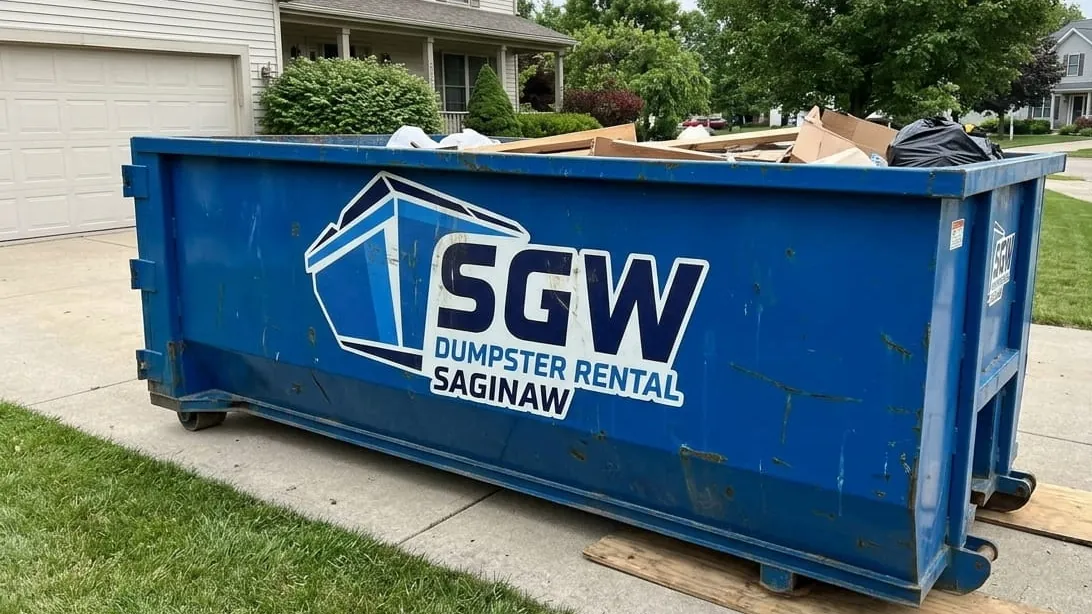
On your own ground. The container sits entirely on your driveway, pad or yard, clear of the sidewalk and clear of the roadway. This is the ordinary residential case and the one we found no permit provision for in the City’s code.
In the right-of-way. The container sits in the street, in a parking lane, partly over the curb, or on the strip between the sidewalk and the road. This is where the City’s code starts to bear on the question and where our research ran out.
If you are not sure which situation you are in, that is itself worth a call — the boundary between private property and the right-of-way is not always where the grass stops.
What we read in the City Code, and what each section actually governs
§ 115.094, Street Occupancy — which is not the section you want
This is the section that looks exactly right and is not. We fetched it in full. It governs a franchise grantee — a utility or cable operator — and it covers pole and facility use, ten days’ advance notice before construction in any street, safety and maintenance, restoration, emergencies, tree trimming, relocation, paving and curb cuts, and conduit. It names no issuing official, only “the grantor.” It sets no permit fee and states no permit duration. Its history reads: Prior Code § 115.079; Ord. D-1485, § 7.10, passed 3 June 1985, effective 13 June 1985.
We flag it because its title makes it look like the container-placement provision, and a page built by skimming section headings would cite it. It is a utility franchise provision. Do not read it as a dumpster permit.
§ 130.19, Obstructing Public Passage or Place — the nearest general rule
This is the closest thing in the City’s code to a general rule about objects in a public way, and it is worth reading carefully because of what it does not contain.
It prohibits a person from purposely or recklessly obstructing, or causing to be obstructed, “any public passage or place” unless the person has “legal privilege to do so.” Subsection (B) reaches blocking traffic on a public street “by means of a barricade, object, or device, or with his or her person.” Subsection (C) prohibits refusing or knowingly failing to obey “a reasonable official order or request to move.” Subsection (D) defines obstruction as making a passage or place unusable “without unreasonable inconvenience or hazard.” Subsections (E) and (F) protect lawful assemblies. History: Prior Code § 130.19; Ord. D-665, passed 8 September 1964, effective 1 November 1964; Ord. D-1119, passed 7 October 1974, effective 17 October 1974. The penalty is at § 130.99, which we did not read.
Now the gap. § 130.19 mentions no permit and no authorization procedure. Its only general qualifier is the undefined phrase “legal privilege,” and its one express exception covers persons maintaining, rearranging or constructing public utility facilities in or next to a street. It does not name alleys or sidewalks — only “public street” in subsection (B) and the broader “public passage or place” in (A).
The conclusion, stated the way the evidence supports it
A container in a City of Saginaw street plausibly engages § 130.19, and § 130.19 provides no permit mechanism we could find. That is a reason for caution, not a basis for a claim in either direction. We also could not read the City’s own operational pages, because the City’s website is not accessible to us beyond its homepage, so any permit process published there is simply outside what we were able to check.
Call the City of Saginaw on (989) 399-1311 before you put a container in a City street. Ask who handles obstructions or encroachments in the right-of-way, and ask whether anything has to be issued. Ten minutes of someone’s time now beats finding out afterwards.
The one thing about the right-of-way that is established
There is a City provision about material in the right-of-way, and it is unambiguous: § 94.068, in Chapter 94, Nuisances; Health and Safety.
It applies when an enforcement officer finds trash, abandoned property or building materials on the street right-of-way next to a property. The officer posts a notice on the material — at least 8 by 10 inches and weatherproof — stating that the material is “improperly stored” and that it “must be removed within 72 hours from the date of this notice.” A copy goes in the mail to the owner of the real property per City Assessor records on or before the posting date, and to the owner of the trash where reasonably identifiable. After the seventy-two hours the officer “may cause such trash to be removed,” and the City’s removal costs are assessed and levied against the premises. History: Prior Code § 94.43; Ord. D-1659, passed 27 July 1992, effective 6 August 1992.
So: loose building materials at the curb in the City are a seventy-two-hour exposure with cost recovery against the property, and the cost lands on the owner rather than on whoever generated the pile. We do not publish the charge-back amount, because the section it runs through was not one we read. The full picture of the City’s refuse provisions is at what the City of Saginaw will not collect.
Outside the City, we have nothing to give you
This is the part a templated page would fabricate, so we will be blunt about it.
Saginaw County has 30 county subdivisions — 3 cities and 27 townships — plus 5 villages inside townships. We read right-of-way and obstruction text for exactly one of them, the City of Saginaw. For the rest we read none.
Buena Vista Charter Township: its Community Development page makes no mention of right-of-way permits or container placement. We could not find one, which is not the same as there being none. (989) 754-6536, or bvct.org.
Saginaw Charter Township: we did not investigate its right-of-way rules at all. (989) 791-9800, or saginawtownship.org.
Every other township and village on this site: call that township or village. If you are not certain which one you are in — and in this county that is a normal thing to be uncertain about — read which government am I in, in Saginaw County? first.
Three authorities own curb space in this county, and you need the right one
A road in this market belongs to one of three bodies, and asking the wrong one wastes a day.
- MDOT holds the state trunklines. Saginaw County sits in MDOT’s Bay Region, office at 5859 Sherman Rd., 989-754-7443. Right-of-way maps: 517-599-6740.
- The Saginaw County Road Commission holds 1,853 miles of road — 506 primary and 1,347 local — across 27 townships.
- A city or village holds its own streets.
On the MDOT side, we read the department’s infrastructure-permit guidance. It requires an approved permit before erecting any part of a structure over or under the state highway right-of-way, and for any other item resulting in a structure over or under it; listed examples are things like on-premise signs, bus shelters, solar panels and charging stations. It also states that a contractor’s disposal or storage site outside the project limits requires a permit, and that commercial and residential driveways require a permit under Public Act 200 of 1969. Containers are not mentioned, and obstructions are not treated as a category. We are not going to assert either way whether a roll-off in a trunkline right-of-way needs an MDOT permit. Call the Bay Region office.
We also did not verify which numbered routes in this county are trunklines, so we publish no list of them.
The other permit, which is a different permit
People often arrive at this question while really asking about a building or demolition permit, which is a separate matter from where a container sits.
Michigan is a single-state-construction-code state under the Stille-DeRossett-Hale Single State Construction Code Act, 1972 PA 230, with codes published by LARA’s Bureau of Construction Codes. The editions in force are worth knowing because they are not what most people assume: the Michigan Building Code is on the 2021 edition while the Michigan Residential Code is on the 2015 edition. A writer who assumes Michigan is uniformly on the 2021 I-codes is wrong about every house.
Enforcement is assigned jurisdiction by jurisdiction and discipline by discipline. LARA publishes a Statewide Jurisdiction List marking each unit as STATE (the Bureau enforces), COUNTY or LOCAL, across building, electrical, mechanical and plumbing. We could not read the Saginaw County rows; the document truncated before them. What we did establish from the township’s own site is that Buena Vista Charter Township runs its own program, with the inspections contracted out to private firms and a zoning administrator from a professional services company.
We did not establish who issues building or demolition permits in the City of Saginaw. We publish no permit fee, no permit timeline, and no statement that a permit is or is not required for any specific job, in any jurisdiction in this market. Those are questions for the office with jurisdiction.
Fire code: we name the department, not a distance
The question underneath “do I need a permit” is often really “where is the container allowed to sit relative to the house.” We publish no separation distance, in any unit, anywhere on this site, and here is why that is the right call rather than a dodge.
Michigan’s statewide fire code is NFPA 1, Uniform Fire Code, 2006 edition, adopted by reference at administrative rule R 29.1652 — not the International Fire Code. Rule R 29.1651 then switches it off: the rules do not apply in a local jurisdiction that has adopted a nationally recognized fire prevention code, and they exclude one- and two-family dwellings and mobile homes in any case. The City of Saginaw enforces the International Fire Code, 2024 Edition under Code § 92.30(A)(1), adopted by Ordinance O-271, passed 23 June 2025, effective 3 July 2025, with the 2015 edition expressly repealed. Saginaw Charter Township has adopted the 2018 International Fire Code with amendments. For Buena Vista Charter Township we could not find a fire-code adoption, and we will not assume the state default applies there.
Three different answers within a few miles, and no source we could read that gives a distance. Ask the fire department with jurisdiction over the address. The detail is at three fire codes, seven miles apart.
Two clocks we can state precisely
Digging. If the project the container is there to serve involves excavation — a deck, a fence, a post, a stump, a pool removal — Michigan’s MISS DIG statute, 2013 PA 174, requires notice “at least 72 hours, but not more than 14 calendar days, before the start of any blasting or excavation” (MCL 460.725(1)). It is a window, not a floor. Michigan’s term for the area within 48 inches of the marks is the caution zone. Call 811, or see missdig811.org and 72 hours and the caution zone. Setting a container on a driveway is not excavation, and whether placement itself triggers any obligation is something we could not establish, so we do not assert it.
Asbestos. A demolition requires a notification to EGLE’s Air Quality Division at least ten working days before work begins — and the notification requirement still applies to demolition activities below the material thresholds, even for facilities with no asbestos. The worker-safety side sits with LEO and MIOSHA, not LARA. See demolition debris and asbestos notification.
What to do, in order
- Work out which government you are in. Your tax bill names the taxing unit; your ZIP code does not.
- Decide whether the container goes on your ground or in the right-of-way. If there is any doubt, treat it as the right-of-way.
- If it is the right-of-way, call that government before delivery. City of Saginaw (989) 399-1311.
- If the job involves digging, call 811 at least 72 hours and not more than 14 calendar days ahead.
- If it is a demolition, ask about the asbestos notification ten working days out.
- Then call us on (989) 272-9034 and describe where the container would have to sit.
There is no quote form, no booking screen and no account on this site, so the conversation happens on the phone. We are locally owned and operated. We are not able to determine permit or fire-code compliance for your address, and we will not pretend to — but we can tell you which desk answers that question.