
Saginaw County service
Demolition Debris Removal in Saginaw, MI
Containers for gut-outs, garages and small structures — and a plain account of the notification question, which catches people out because it applies even when there is no asbestos at all.
- City ordinance quoted by section
- 17 communities, 19 governments
- Call-only — no quote form
- We say what we could not verify
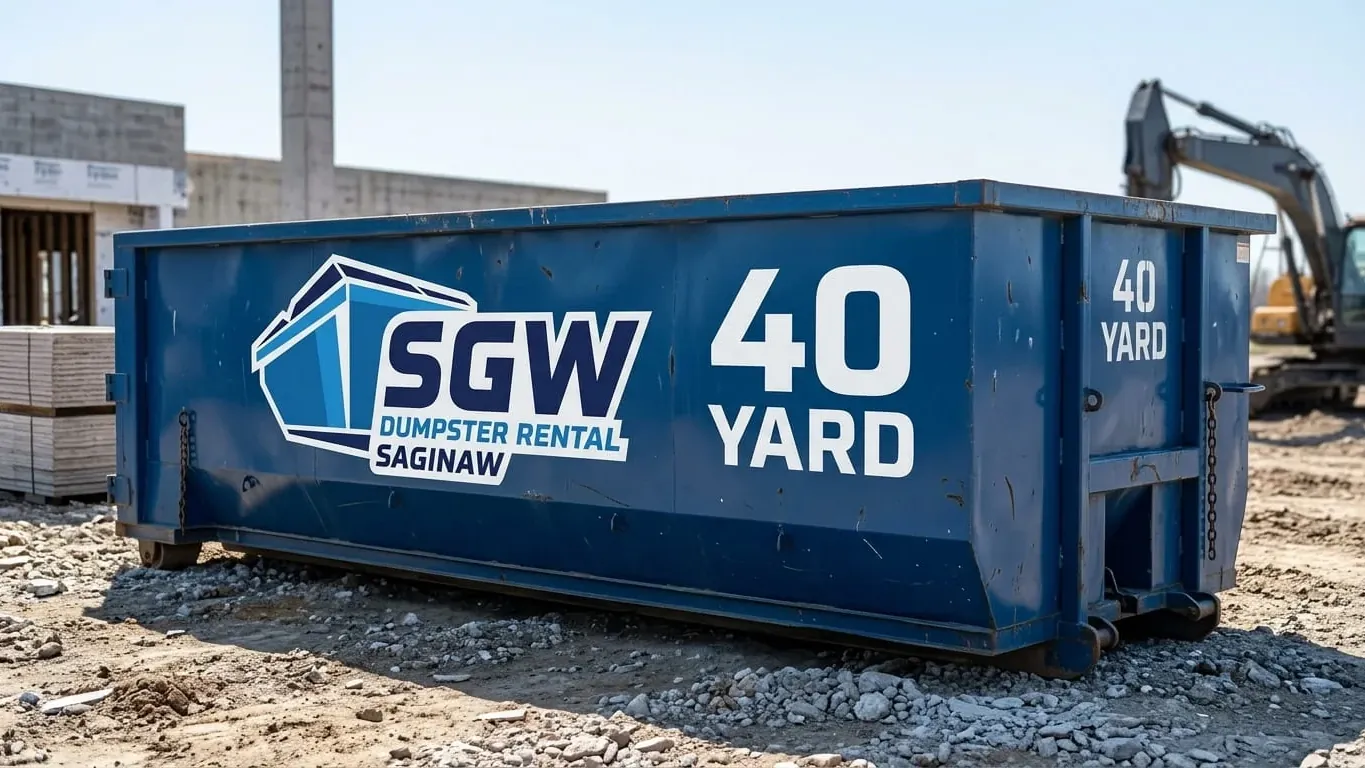
Demolition Debris Removal across Saginaw County
Demolition is the one job on this site where the container is genuinely the easy part. Before anything comes down, there is a notification question, and it is the single most misunderstood rule in this trade. People assume the rule is about asbestos, so if there is no asbestos there is nothing to file. That is not what the regulator says.
Michigan's environmental agency, EGLE, administers the federal asbestos NESHAP program through its Air Quality Division. Its own fact sheet states that the notification requirement applies to “demolition activities below the thresholds (even for facilities with no asbestos).” The square-foot and linear-foot thresholds govern renovation. A demolition is notifiable regardless. The notice period is ten working days before work begins, through EGLE's MiEnviro Portal, and MCL 324.5519(3) requires a $100 fee for each original notification.
There is a residential exemption, it is real, and it is narrower than people think. It is set out below with its exact boundaries, because the version that circulates — “houses are exempt” — is wrong often enough to cost somebody a project schedule.
At a glance
What you get with demolition debris removal
- The notification question dealt with before the container question
- Containers sized for dense demolition material rather than for the building's footprint
- EGLE and LEO named correctly, with the Saginaw County contact given
- No guesswork about what is in the structure, from us or from anybody else
The notification comes before the container
Here is the sequence that keeps a demolition on schedule. A thorough inspection first: EGLE's fact sheet states that “the asbestos NESHAP requires that a thorough inspection be conducted for all renovations and all demolitions,” completed before work starts, with the inspecting contractor named on the joint EGLE and LEO notification form. A visual-only inspection is not acceptable unless the building is primarily steel and concrete or is unlikely to contain asbestos.
Then the notification, submitted through the MiEnviro Portal at least ten working days before work begins. Non-scheduled renovations can be covered by an annual notice filed ten working days before the start of the calendar year. Ordered demolitions and emergency renovations are notified no later than the following work day. The fee is $100 for an original notification under MCL 324.5519(3), with revisions at $10, and there is a detail worth noticing: if the fee is not paid, the notification is not considered submitted. Combined with a ten-working-day clock, an unpaid fee is a schedule problem rather than an accounting one.
Two agencies, named correctly, because out-of-state pages get this wrong. The environmental side is EGLE. The worker-safety side is MIOSHA, within Michigan LEO. It is not the state's licensing department. Saginaw County's asbestos NESHAP inspector is listed by EGLE as Steve Kidder, 517-243-4492.
Our part is narrow and we will not overstate it. Asbestos work is a separate trade with its own requirements under EGLE and MIOSHA. We supply containers. The inspection and the notification belong to the project, and we do not file either of them on anybody's behalf.
The residential exemption, and exactly where it stops
The exemption exists and it is worth quoting precisely. It covers “residential buildings having four or fewer dwelling units that are under private control or ownership.” Three limits are built into that sentence, and each of them removes a real project from the exemption.
Four or fewer dwelling units. A building with five or more units is covered. A small apartment block is not a house for this purpose. Private control or ownership. A privately owned home not being demolished for urban renewal, and not part of a public or commercial project, is listed as not subject. Change either of those conditions and the exemption falls away: a municipally ordered demolition, or one carried out as part of a public program, is a different case from the same house taken down by its own owner. There is also a specific and counter-intuitive inclusion — residential dwellings intentionally burned for fire training are covered.
Put those together and the sentence people repeat, that houses are exempt from asbestos rules in Michigan, is wrong at three separate edges. It is also worth holding it alongside the first section: demolitions below the thresholds still require notification even where there is no asbestos. The exemption and the notification duty are two different questions, and answering the first one does not answer the second. If you are unsure which side of any of these lines a project falls on, the county inspector and EPA's NESHAP material are the places to settle it before a machine is booked.
What goes in the container, and how the weight behaves
Once the paperwork is clear, the material question is straightforward. The City of Saginaw's ordinance describes the category exactly: Section 50.06(C) says the collection will not pick up “stones, bricks, plaster, shingles, lumber, demolition materials, building materials, concrete, sand, gravel, and earth,” and Section 50.06(I) separately excludes “material resulting from contract work,” naming construction or demolition among its own examples. A demolition load is excluded twice over, and that is the City's own wording rather than ours.
In the box, the thing to plan for is density. A gut-out that is plaster, lath, tile and mortar reaches the weight a loaded truck can lawfully carry on the road while the container still looks usable, so a smaller container swapped more than once beats one oversized box that cannot be lifted. Masonry and concrete are better kept in a dedicated heavy container than mixed through general demolition waste, because a clean single-material load has somewhere straightforward to go and a contaminated one does not.
Keep the site tidy while it runs. If demolition material ends up on the street right-of-way next to the property, Section 94.068 applies: an enforcement officer posts a weatherproof notice that the material is “improperly stored” and must be removed “within 72 hours from the date of this notice.” Those sections are in the City's code and they govern the City. We did not read the equivalent ordinances for the other sixteen communities we serve.
Suitability
When demolition debris removal is the right call, and when it is not
Read both columns against what is actually going to come out of the building before anything is booked. It is a short job and it decides the size.
Good fits for this container
- Detached garage, carport and shed teardowns
- Interior gut-outs back to the studs
- Porch, deck, chimney and small accessory structure removal
- Clearing a slab and footings after a structure is down
Send these somewhere else
- Any structure whose inspection and notification are not yet complete
- Material with known or suspected asbestos content still in place
- Fuel tanks, drums of unknown liquid and contaminated soil
Sizing
Container sizes that run on demolition debris removal
Every size below runs on this service. Choose on the density of the material and the cubic yards look after themselves, because what ends a dense load is the weight the loaded truck can lawfully carry on a public road.
- 10 yard — Plaster, lath, tile, mortar and masonry, where weight arrives long before the box is full.
- 15 yard — A garage or a single-room gut-out of mixed density.
- 20 yard — A larger interior strip-out where some of the load is genuinely bulky and light.
- 30 yard — Bulky demolition waste such as framing, siding and roof structure, swapped as it fills.
| Size | Dimensions | Capacity | What fills it first | Best for |
|---|---|---|---|---|
| 10 Yard Dumpster | about 14 ft long × 7.5 ft wide × 3.5 ft high | about 50-70 kitchen-size trash bags | Weight, with the box still half empty | Concrete, block, tile, dirt and roof tear-off. |
| 15 Yard Dumpster | about 16 ft long × 7.5 ft wide × 4.5 ft high | about 80-100 kitchen-size trash bags | Usually weight, on a mixed load | Garage clearing, flooring tear-out and one heavy room. |
| 20 Yard Dumpster | about 22 ft long × 7.5 ft wide × 4.5 ft high | about 110-130 kitchen-size trash bags | Either, depending what goes in | Most remodels, and a house being emptied room by room. |
| 30 Yard Dumpster | about 22 ft long × 7.5 ft wide × 6 ft high | about 170-190 kitchen-size trash bags | Volume, on bulky light material | Multi-room work and a full estate clearance. |
| 40 Yard Dumpster | about 22 ft long × 7.5 ft wide × 8 ft high | about 230-250 kitchen-size trash bags | Volume, almost always | New construction and bulky demolition waste. |
Demolition Debris Removal in Saginaw County: the local specifics
One jurisdictional point matters here more than on any other page. The asbestos NESHAP rules are federal, administered in Michigan by EGLE, and they apply the same way regardless of which Saginaw County government your site sits in. The building rules do not work like that. Michigan runs a single state construction code, but enforcement is assigned jurisdiction by jurisdiction, and we could not read the Saginaw County rows of the state's jurisdiction list, so we do not say who issues a demolition permit where.
The county has thirty subdivisions and five villages inside townships, and a Saginaw mailing address does not identify your government. Confirm the local permit route with the city, township or village before the notification clock starts, because the two run in parallel. Saginaw County publishes its department contacts. We will not assert any approval, endorsement or working relationship with the City, the County, the Land Bank or any state agency, because we have none to assert.
Talk to a real person
Demolition Debris Removal across Saginaw County, one call away
One short call does it. Describe the material and the access, and name the community the address sits in — the City of Saginaw is the one jurisdiction on our list whose refuse ordinance we were able to read and quote by section, and we will tell you plainly when yours is not it. Call (989) 272-9034.
Call and ask what the board looks like today
Answers
Demolition Debris Removal — your questions answered
Do I need an asbestos notification even if there is no asbestos?
For a demolition, yes. EGLE's own fact sheet says the notification requirement applies to demolition activities below the thresholds, even for facilities with no asbestos. The square-foot and linear-foot thresholds govern renovation work. A demolition is notifiable regardless of what the inspection finds, which is the single most commonly missed rule in this area.
What does the notification cost and how far ahead must it be filed?
MCL 324.5519(3) requires a $100 fee for each original notification, with revisions at $10, and the notice goes to EGLE through the MiEnviro Portal at least ten working days before work begins. If the fee is not paid, the notification is not considered submitted. Ordered demolitions and emergency renovations are notified no later than the following work day.
Does the four-dwelling-unit exemption cover my house?
It covers residential buildings having four or fewer dwelling units that are under private control or ownership. It falls away for buildings of five or more units, and for demolitions carried out for urban renewal or as part of a public or commercial project. Residential dwellings intentionally burned for fire training are specifically covered. Check the boundaries against your own project rather than assuming a house is outside the rules.
Who is the asbestos NESHAP inspector for Saginaw County?
EGLE's published asbestos program contacts list Steve Kidder for Saginaw County, on 517-243-4492. EGLE's own asbestos landing page notes that contact assignments change, so confirm it is current before relying on it. The environmental program sits with EGLE and the worker-safety side sits with MIOSHA inside Michigan LEO, not with the state's licensing department.
Do you handle the asbestos side of a demolition?
No. Asbestos work is a separate trade with its own requirements under EGLE and MIOSHA, and we supply containers. The thorough inspection required before any demolition, and the notification that follows it, belong to the project. We do not file them, we do not survey buildings and we will never tell you a structure is clear.
Will the City of Saginaw collect demolition material at the curb?
Section 50.06(C) says the City's collection will not pick up stones, bricks, plaster, shingles, lumber, demolition materials, building materials, concrete, sand, gravel and earth. Section 50.06(I) separately excludes material resulting from contract work, with demolition given as one of the ordinance's own examples. Those are City sections; for the sixteen other communities on our list we read no refuse ordinance at all.
Service area
Demolition Debris Removal across Saginaw County
We run containers out of 3102 Sawyer Dr to seventeen communities in Saginaw County. They are grouped below by what kind of government each one actually is, because in Michigan that is the difference between a city hall, a township board and a village that sits inside a township — and it decides who you have to call about your own address. If yours is not listed, call anyway; we most likely still get there.
The city
The only jurisdiction in this list whose refuse rules we were able to read and quote.
Townships
A township board, not a city hall. We could not establish container or refuse rules for any of these, and we do not publish ones we could not read.
- Buena Vista TownshipCharter Township
- Carrollton Township2.5 mi straight-line
- Kochville Township5.6 mi straight-line
- Saginaw TownshipCharter Township
- Blumfield Township7.0 mi straight-line
- Bridgeport TownshipCharter Township
- Spaulding Township9.7 mi straight-line
- James Township10.7 mi straight-line
- Thomas Township11.4 mi straight-line
- Tittabawassee Township11.8 mi straight-line
- Taymouth Township13.8 mi straight-line
- Swan Creek Township14.3 mi straight-line
Other incorporated places
Two cities and two villages. A village sits inside its township, so a village address has two governments over it at once.