
Saginaw County service
Roofing Dumpster Rental in Saginaw, MI
Tear-off containers sized against the weight of shingles rather than the space they take up, which is why the right box for a roof is almost always one of the small ones.
- City ordinance quoted by section
- 17 communities, 19 governments
- Call-only — no quote form
- We say what we could not verify
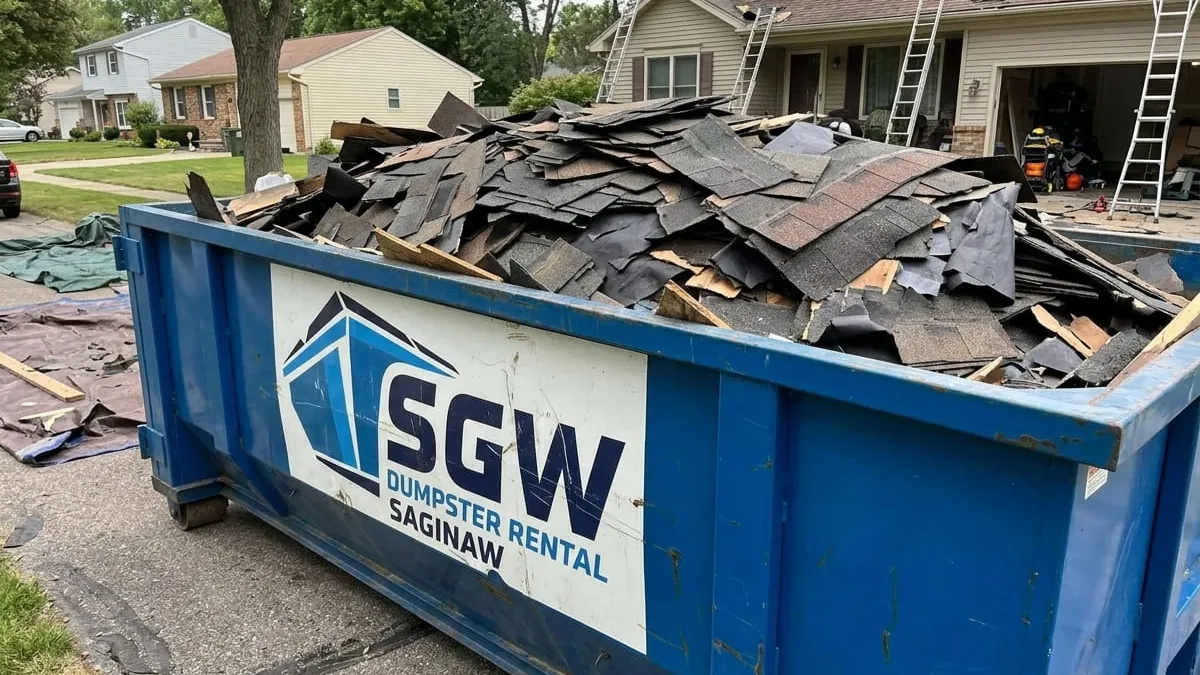
Roofing Dumpster Rental across Saginaw County
Roofing is the one job where the City's ordinance names your material by name. Section 50.06(C) lists what the City's collection will not pick up, and the list reads “stones, bricks, plaster, shingles, lumber, demolition materials, building materials, concrete, sand, gravel, and earth.” Shingles are in the ordinance, in plain sight, with amendment history attached. If a crew did the tear-off, Section 50.06(I) catches it a second time as material resulting from contract work.
Even if that were not so, the curb was never a realistic route. Section 50.05 caps a refuse container at 35 gallons and states that “the weight of the container and its contents may not exceed 50 pounds,” and Section 50.06(B) excludes “small items in piles requiring a shovel or fork to handle.” A layer of shingles off an average roof is not going to meet any of that.
So the container is the route, and the only real decision is the size — which is where roofing differs from every other job on this site. Tear-off is dense. The weight the loaded truck can lawfully carry on the road arrives long before the box is full. That is why a roof almost never belongs in a 30 or a 40, and why anyone offering you the biggest box on the lot for a tear-off is selling air you cannot use.
At a glance
What you get with roofing dumpster rental
- Sized against the weight of the tear-off rather than the square footage
- Positioned on the side the material is coming off, before the first shovel
- Plywood under the wheels and both rails on the drive
- Section-by-section on what the City will and will not take, so you can check it
Why a roof goes in a small box
The intuition most people bring is volume: a bigger roof needs a bigger container. For tear-off, that intuition is backwards. Shingles are heavy for the space they occupy, and a loaded container has to go out on a public road within what the truck can lawfully carry. Fill a 30 yard box with tear-off and you reach that limit with most of the box still empty — which does not get you a bigger load, it gets you a container that cannot be lifted and a second trip you did not plan.
A 10 or a 15 is therefore the normal answer, loaded flat and level rather than heaped. Two containers in sequence, or one swapped partway through the strip, is a better plan than one oversized box, and for a crew working to a weather window the swap is usually the faster option anyway.
Layers matter more than area. A roof carrying a second or third layer sends down a multiple of what the same square footage would produce stripped to the deck once, and the decking itself, if it is coming off, is a different material again. Felt, ice-and-water membrane, flashing, nails and the sweep-up at the end all add to the pile. When you call, the useful facts are the number of layers, roughly how many squares, whether the deck is coming off, and whether anything other than the roof is going in the same box. That is enough to get the size right the first time.
Placement for a tear-off, and the ground under it
A tear-off container earns its position. Set it on the side the material is actually coming off, close enough that the debris lands in it rather than on the lawn, and clear of anything that cannot take a dropped bundle. The driver will walk the approach before the box comes off the truck, and the box needs a straight run in, overhead clearance for the hoist and room at the back to tip.
Roofing debris arrives hard and fast, and a loaded tear-off container is as heavy as anything we set down. Plywood goes under the wheels and under both rails. Saginaw sits on a flat, clay-rich lake plain, and the surface behaves differently depending on the week: firm and dry carries a loaded container without trouble, while ground that has taken a wet stretch or is cycling through freeze and thaw does not. We are not qualified to assess the ground at any address, so tell us about the drive before the day rather than on it.
Keep the debris field tidy as you go. If material ends up in the street right-of-way beside the property, Section 94.068 is the section that applies: an enforcement officer posts a weatherproof notice that the material is “improperly stored” and must be removed “within 72 hours from the date of this notice,” with a copy mailed to the owner of record and removal costs assessed against the premises.
Suitability
When roofing dumpster rental is the right call, and when it is not
Read both columns against what is actually going to come out of the building before anything is booked. It is a short job and it decides the size.
Good fits for this container
- A single-family tear-off down to the deck
- Garage, porch and dormer roofs as a standalone job
- Stripping a second or third layer off an existing roof
- Flat and low-slope tear-off with membrane and insulation board
Send these somewhere else
- A roof plus a whole-house remodel loaded into one container
- Mixing broken concrete or masonry in with the shingles
- Roofing material suspected of containing asbestos, which is a separate trade
Sizing
Container sizes that run on roofing dumpster rental
Every size below runs on this service. Choose on the density of the material and the cubic yards look after themselves, because what ends a dense load is the weight the loaded truck can lawfully carry on a public road.
- 10 yard — The standard tear-off container. A straightforward single-layer roof, loaded flat.
- 15 yard — A larger footprint, a second layer, or a roof plus the decking coming off with it.
- 20 yard — Only where the roof is being stripped alongside genuinely light material such as soffit and trim.
| Size | Dimensions | Capacity | What fills it first | Best for |
|---|---|---|---|---|
| 10 Yard Dumpster | about 14 ft long × 7.5 ft wide × 3.5 ft high | about 50-70 kitchen-size trash bags | Weight, with the box still half empty | Concrete, block, tile, dirt and roof tear-off. |
| 15 Yard Dumpster | about 16 ft long × 7.5 ft wide × 4.5 ft high | about 80-100 kitchen-size trash bags | Usually weight, on a mixed load | Garage clearing, flooring tear-out and one heavy room. |
| 20 Yard Dumpster | about 22 ft long × 7.5 ft wide × 4.5 ft high | about 110-130 kitchen-size trash bags | Either, depending what goes in | Most remodels, and a house being emptied room by room. |
| 30 Yard Dumpster | about 22 ft long × 7.5 ft wide × 6 ft high | about 170-190 kitchen-size trash bags | Volume, on bulky light material | Multi-room work and a full estate clearance. |
| 40 Yard Dumpster | about 22 ft long × 7.5 ft wide × 8 ft high | about 230-250 kitchen-size trash bags | Volume, almost always | New construction and bulky demolition waste. |
Roofing Dumpster Rental in Saginaw County: the local specifics
Weather sets the pace on a Saginaw roof more than the calendar does. The National Weather Service office covering Saginaw County is Detroit/Pontiac, and its 1991–2020 monthly normals for the station labeled SAGINAW show January and February as the only two months whose average high sits below freezing, at 29.5 and 31.8 degrees. Five months carry a zero snowfall normal and four carry six inches or more, with January alone at 13.9 inches. August, not spring, is the wettest month on that table at 3.85 inches.
Practically, that means a tear-off window here is usually about getting the strip and the dry-in done between wet spells rather than about temperature, and a container that is already on site when the window opens is worth more than one that has to be scheduled into it. Call and ask what the board looks like before you commit a crew. Those normals are the weather office's figures for that station, not a forecast for your street.
Talk to a real person
Roofing Dumpster Rental across Saginaw County, one call away
One short call does it. Describe the material and the access, and name the community the address sits in — the City of Saginaw is the one jurisdiction on our list whose refuse ordinance we were able to read and quote by section, and we will tell you plainly when yours is not it. Call (989) 272-9034.
Call and ask what the board looks like today
Answers
Roofing Dumpster Rental — your questions answered
Why will you not put a roof tear-off in a 30 yard container?
Because the box would reach the weight a loaded truck can lawfully carry on the road while it still looked half empty, and at that point it cannot be lifted. A larger container does not give you more capacity for a dense material; it gives you unusable space and a problem on collection day. For tear-off, a 10 or a 15 loaded flat, swapped if needed, is the honest answer.
Does the City of Saginaw collect shingles at the curb?
Section 50.06(C) lists shingles by name among the materials the City's collection will not pick up, alongside stones, bricks, plaster, lumber, demolition materials, building materials, concrete, sand, gravel and earth. If a contractor did the work, Section 50.06(I) also covers it as material resulting from contract work. That is the City's ordinance; it does not speak for any other community.
What should I tell you when I call about a roof?
Four things get the size right: roughly how many squares, how many layers are coming off, whether the decking is coming off too, and whether anything other than the roof is going in the same box. If you are working to a weather window, say that as well, because it changes whether a swap mid-strip makes more sense than a single container.
Where should the container sit during a tear-off?
On the side the material is coming off, close enough that debris lands in the box rather than on the lawn, with a straight approach for the truck, overhead clearance for the hoist and room to tip at the back. Plywood goes under the wheels and both rails. If the drive is short, sloped or shared, say so on the phone so the approach is planned rather than improvised.
What if the old roofing might contain asbestos?
Stop and get it identified before anything comes off. Asbestos work in Michigan sits with EGLE on the environmental side and with LEO's MIOSHA on the worker-safety side, and a demolition or renovation carries its own inspection and notification requirements. We run containers; we are not the people to make that determination, and we will not tell you a roof is clear.
Service area
Roofing Dumpster Rental across Saginaw County
We run containers out of 3102 Sawyer Dr to seventeen communities in Saginaw County. They are grouped below by what kind of government each one actually is, because in Michigan that is the difference between a city hall, a township board and a village that sits inside a township — and it decides who you have to call about your own address. If yours is not listed, call anyway; we most likely still get there.
The city
The only jurisdiction in this list whose refuse rules we were able to read and quote.
Townships
A township board, not a city hall. We could not establish container or refuse rules for any of these, and we do not publish ones we could not read.
- Buena Vista TownshipCharter Township
- Carrollton Township2.5 mi straight-line
- Kochville Township5.6 mi straight-line
- Saginaw TownshipCharter Township
- Blumfield Township7.0 mi straight-line
- Bridgeport TownshipCharter Township
- Spaulding Township9.7 mi straight-line
- James Township10.7 mi straight-line
- Thomas Township11.4 mi straight-line
- Tittabawassee Township11.8 mi straight-line
- Taymouth Township13.8 mi straight-line
- Swan Creek Township14.3 mi straight-line
Other incorporated places
Two cities and two villages. A village sits inside its township, so a village address has two governments over it at once.