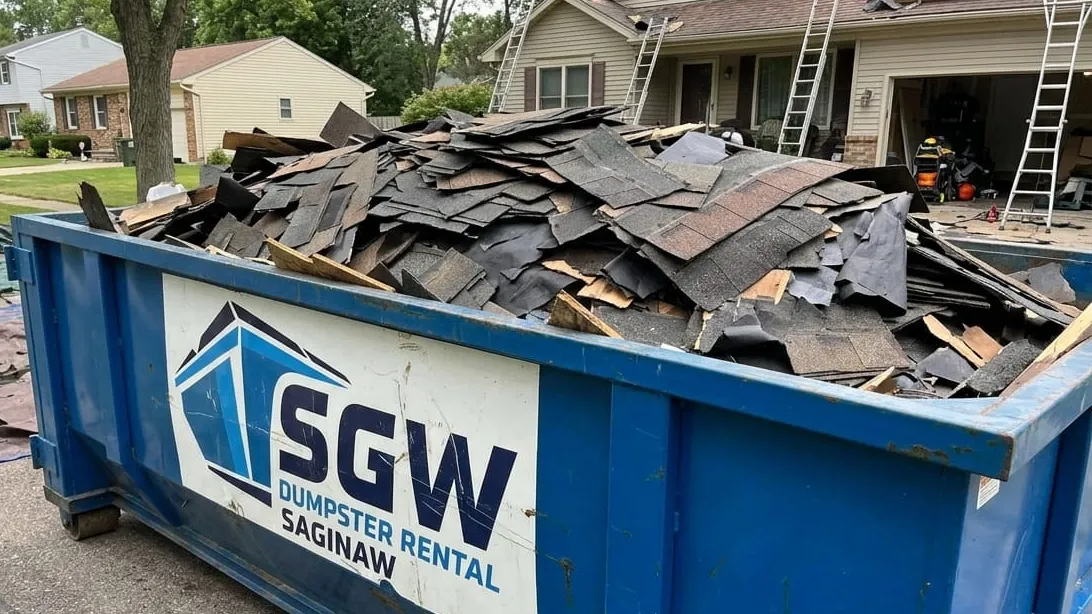
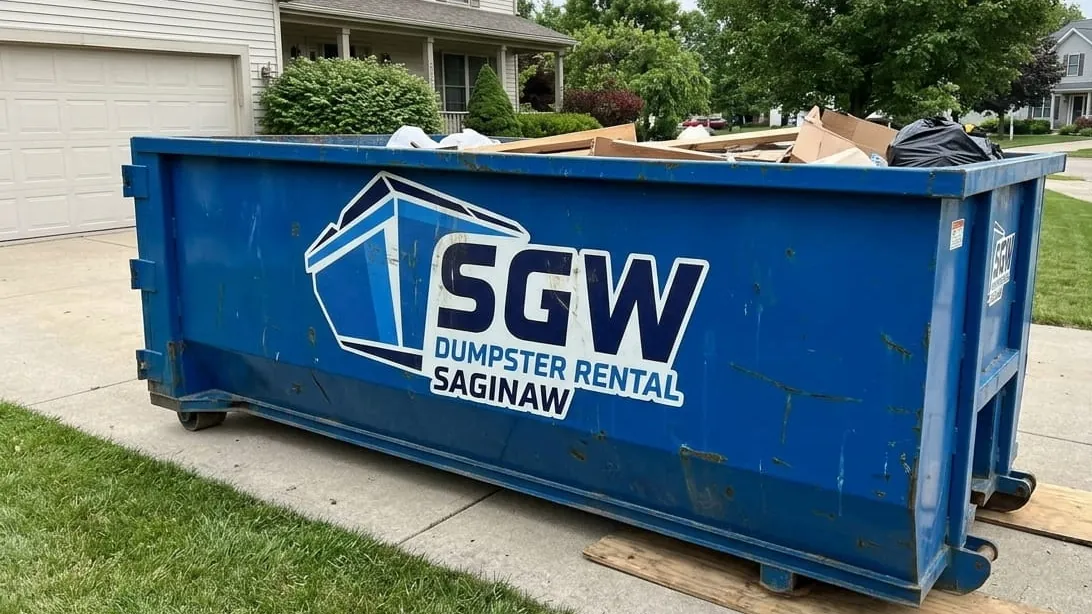
There is one rule about roofing containers that is worth more than everything else on this page put together, so here it is first: a tear-off does not go in a 30 yard or a 40 yard container. Not a large one, not a small one, not “to be safe.”
That sounds backwards. Bigger is normally safer. On a roof it is not, and the reason is that roofing is the one common job where the material runs out of weight long before it runs out of space. A 30 or a 40 is a volume solution to a weight problem. Fill either one with shingles and you have a box that cannot lawfully move, sitting on a driveway, with a truck that cannot take it.
The rest of this article explains that properly, works through what actually changes the number on a Saginaw-area roof, and covers the local part — because in the City of Saginaw the City’s own ordinance names shingles, by that word, among the materials it will not collect.
Roofing fills by weight, and nothing else does quite the same way
Think about what else goes in a container. A house clear-out is bags and furniture: bulky, light, mostly air. Drywall from a remodel is sheets with voids between them. Brush is branches and gaps.
A tear-off is none of that. Stripped shingles stack and nest. They lie flat, they interlock, they settle under their own weight as the box fills, and by the end they are a dense slab rather than a pile. The volume you see from the driveway is not the volume the material is using.
Three things compound it, and all three are common on an older roof:
- Layers. A roof that has been covered over once — or twice — is carrying the whole weight of every layer, and all of it comes off at the same time. Two layers is not a little more than one.
- Water. Shingles and felt hold water, and a tear-off that gets rained on part way through gains weight without gaining a single square of coverage. In this market that is not a remote possibility: at the station the National Weather Service labels simply “SAGINAW,” the 1991 to 2020 normals make August the wettest month of the year, ahead of every spring month.
- What comes off with the shingles. Old felt, ice-and-water membrane, nails, flashing, drip edge, and — the big one — any decking that has to be replaced. Rotten plywood is heavy, wet rotten plywood is heavier, and decking replacement is the single most common reason a roofing job needs more container than it was quoted for.
We are not going to put a pounds-per-square figure on this page. We did not source one, and a number invented to look authoritative is worse than no number. What we will tell you is the shape of the problem, which is the part that actually governs your decision.
So why not just use a big box anyway?
Because the constraint is not the container. It is the road.
A loaded roll-off has to be driven away on public streets, under the same weight rules as any other truck. The lawful limit sits on the axles of the vehicle, not on the walls of the box. A 30 or a 40 yard container is a great deal of cubic capacity relative to what a truck can legally carry when the cubic capacity is full of something dense. Load one of those with a tear-off and you reach the road limit somewhere well short of the top — at which point you have:
- paid for capacity that physically cannot be used;
- a container that may be sitting on a driveway it is too heavy to be dragged off without tearing the surface;
- a job that stops while the box is dealt with, rather than one that keeps moving.
A smaller container swapped more often is slower on paper and faster in practice. Two 15s that both leave full beat one 40 that leaves half-full and late.
This is not a Saginaw rule or a company rule. It is the physics of dense material in a box that is measured in cubic yards while the road sets its limit in pounds, and it is why roofing is the one service where the honest advice is to go down the size list rather than up. The relevant pages here are the 10 yard, the 15 yard and the 20 yard — and for anything we would call a roofing job, that is the whole list.
What we need to know to get the number right
We are not going to pick a size for your roof from a web page, and you should be suspicious of a calculator that offers to. Here is what actually moves the answer, in roughly the order it matters:
- Squares. The roof area in roofing squares, or the footprint plus a rough pitch if you do not know the square count. Your roofer will have it.
- Layers. How many are coming off. If nobody knows, somebody should lift a corner and look before the container is ordered, not after.
- Material. Architectural shingles, three-tab, cedar, roll roofing, built-up, rubber membrane. They do not behave alike.
- Decking. Whether any is being replaced and roughly how much. This is the swing factor.
- Whether the roof is going on in stages. A front-and-back split over two weeks is a different container plan from one continuous strip.
- Where it can sit, and what it has to cross to get there. Which brings in the next section.
Call (989) 272-9034 with those six answers and the conversation takes about two minutes. There is no quote form, no booking screen and no account on this site, which means nobody is going to make you guess at a drop-down menu for any of the above.
The local part: the City of Saginaw names shingles
This is the piece that no national roofing-dumpster page will tell you, because it requires reading one city’s ordinance.
In the City of Saginaw, City Code § 50.06 is headed materials not to be collected, and subsection (C) reads: “Stones, bricks, plaster, shingles, lumber, demolition materials, building materials, concrete, sand, gravel, and earth.”
Shingles. By name, in the list, between plaster and lumber. Also lumber — which is your decking — and building materials, which covers the rest of it.
Subsection (I) closes the other door. It excludes “Material resulting from contract work”, with examples given as “landscaping, tree trimming, construction or demolition, or work done by utility companies.” So if a roofer did the work, the debris is outside City collection on that basis too, quite apart from being shingles.
And the household ceiling closes the third. § 50.05 requires approved containers to be rust-resistant, covered and tapered, with a capacity of 35 gallons or less, and states that “The weight of the container and its contents may not exceed 50 pounds.” Where the City Manager approves plastic bags, “Each household may set out no more than 20 bags per week.” The section also lists prohibited containers outright: metal or fiber drums, barrels, paper shopping bags, cardboard boxes, anything with sharp or jagged parts, anything over 35 gallons, anything likely to fall apart, and containers without adequate handholds.
Fifty pounds. One tear-off bundle is a problem at fifty pounds, and a roof is not one bundle.
Two things we are careful about here, and you should be too:
- The ordinance does not require anyone to rent a dumpster. It says what the City will not collect. What you do about that is your decision, and renting a container is one option among several.
- These are City of Saginaw provisions only. Saginaw County has thirty county subdivisions — three cities and twenty-seven townships — plus five villages inside townships. We established refuse provisions for the City and for nobody else. If your mailing address reads Saginaw but your government is a township, § 50.06 is not your rule, and we are not going to pretend we know what is. Call that township.
The City’s code was current through Ordinance O-274, passed 22 September 2025, effective 2 October 2025, when we read it at the City’s codifier. Ordinance history on § 50.06 runs through amendments in 1992, 2003 and 2015.
And do not leave it at the curb while you think about it
One more City provision, because it has a number on it and the number is short. § 94.068 deals with trash, abandoned property or building materials on the street right-of-way next to a property. An enforcement officer posts a weatherproof notice of at least 8 by 10 inches saying the material is improperly stored and “must be removed within 72 hours from the date of this notice”, and mails a copy to the property owner per City Assessor records. After 72 hours the officer may cause the trash to be removed, and the City’s removal costs are assessed and levied against the premises.
Note who the bill goes to: the premises. The property owner, not the roofer who generated the pile. That is worth knowing if you are a homeowner whose contractor is planning to come back for the debris “next week.”
Where to put it, on a roofing job specifically
Roofing containers get loaded from above, fast, by people who are tired. Placement matters more than on most jobs.
- Close to the drip line, on the side with the most roof. Every foot of carry is a foot somebody walks with an armload of wet shingles.
- Clear of the gutters you are keeping and clear of anything you would rather not have a bundle land on — AC units, meters, downspouts, shrubs, a car that will be moved and then not moved.
- Mind what is overhead. A roll-off goes up on the truck to be loaded and unloaded, and the truck needs vertical room. Low branches, service drops and porch roofs all matter.
- Think about the surface. A loaded roofing container is about as heavy as anything we set down, concentrated on wheels and two rails. Put plywood under the wheels and both rails. We have a whole article on driveway protection on the lake-plain ground around here, and the short version is that firm dry ground carries a loaded box and ground that has had a wet week or has been through a freeze and thaw does not. We are not qualified to assess the ground at your address and we will say so on the phone.
- If it has to go in the street, ask first. We could not establish whether the City of Saginaw requires a permit for a container in a City street, or who would issue one — the provision that looks like it should cover it turns out to be a utility franchise provision, and the general obstruction provision we did read contains no permit mechanism we could find. So we are not saying a permit is needed and we are not saying one is not. Call the City at (989) 399-1311.
Timing a tear-off in this climate
From the National Weather Service Detroit/Pontiac monthly normals for 1991 to 2020, at the station labeled “SAGINAW,” a few things are worth having in front of you when you book:
- Five months carry a zero snowfall normal — May through September. That is the clean window.
- Four months carry a snowfall normal of six inches or more — December, January, February and March. January’s normal is 13.9 inches on its own.
- January and February are the only months whose average high is below freezing, at 29.5 and 31.8 degrees Fahrenheit.
- August is the wettest month, at 3.85 inches, ahead of May at 3.41 and June at 3.28. The driest are February at 1.77 and December at 1.85.
Those are normals for one station, published by the local forecast office at weather.gov/dtx, and they are not a forecast for your week. The practical reading is that late summer is reliably open but not reliably dry, and that a tear-off scheduled into a wet stretch means a heavier load from the same roof. If the forecast turns, call and move the delivery rather than letting an open roof and an open container both take the rain.
What we are not going to tell you
Three things, deliberately.
We are not going to publish a weight allowance, a rate, an included tonnage or an overage figure on this page. Sizing a roofing container is a weight conversation, and a weight conversation that happens through a web form instead of a phone call is how people end up surprised. Call and ask.
We are not going to tell you which specific size your roof needs before you have told us the six things above. A roofing calculator that answers from the square count alone is ignoring the layer count and the decking, which are the two variables that actually decide it.
And we are not going to tell you what any particular disposal site will or will not take, or name one. We did not verify any facility’s accepted materials, so we are not going to send you to one.
The call
(989) 272-9034. Locally owned and operated, call-only — no quote form, no booking screen and no account. Tell us the squares, the layers, the material, the decking situation, the staging and where the box can sit, and we will tell you what we would send and why. If the answer is “two smaller ones rather than one big one,” we will say that, because on a tear-off it usually is.
Also on this site: roofing dumpster rental, roll-off dumpster rental, construction dumpster rental and same-day availability — which is a page about asking what the board looks like today, not a promise. Related reading: what size do I need?, what the City will not collect and 35 gallons, 50 pounds, 20 bags.