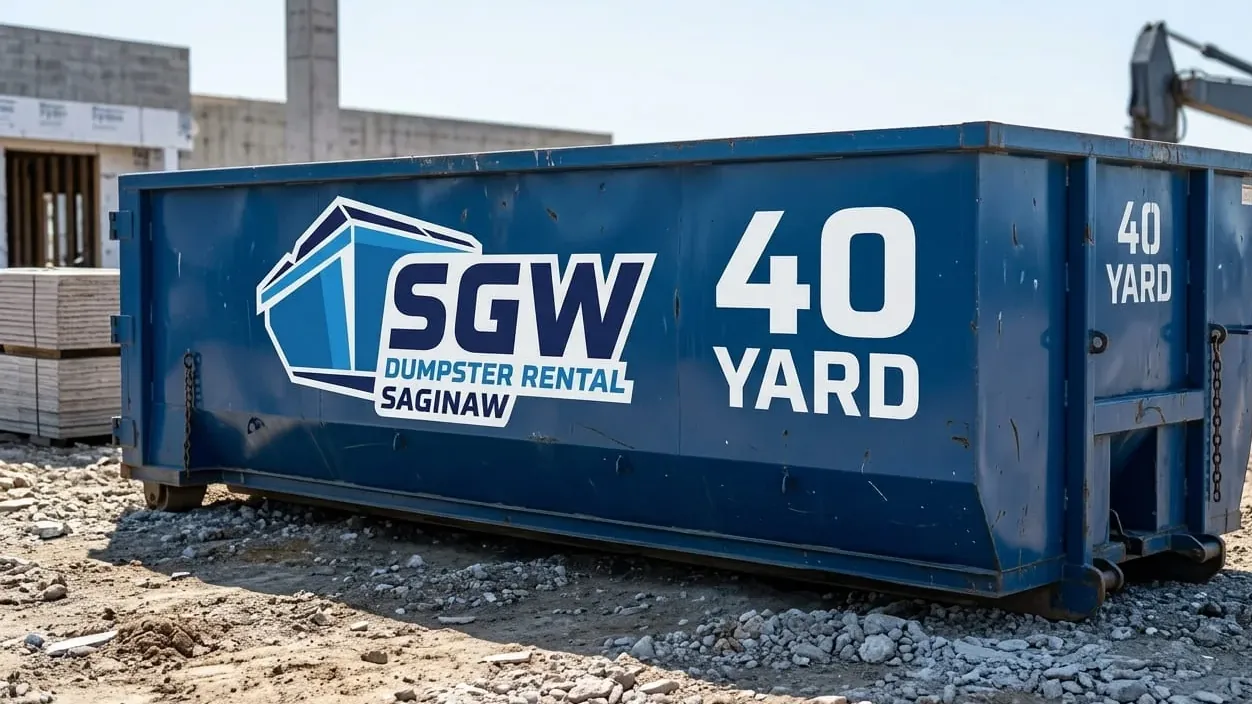
The fire-code question almost always arrives as a placement question. Someone is standing in a driveway with a tape measure, looking at the siding, and wants to know how far from the building the container has to sit. It sounds like the kind of thing a dumpster company ought to be able to answer in one sentence.
We are not going to answer it with a number, and this article is the long version of why. The short version is that there is no single fire code in force across this market. There are at least three answers inside a few miles of each other, we could not establish a fourth, and none of the documents we were able to read gave us a distance we could stand behind. So instead of a number, what follows is the map: which code governs where, how we know, and the name of the office that can actually answer for your address.
If that sounds like less than you wanted, it is also more than a confident wrong number is worth. A distance invented to sound authoritative is the single easiest way for a page like this to get someone written up.
Start with the state, because the state answer is not the one most people expect
Nearly every national page about dumpsters and fire safety says some version of “under the International Fire Code…” In Michigan, at state level, that is wrong.
Michigan’s statewide fire code sits in the Bureau of Fire Services’ fire prevention administrative rules, and the adopting rule is Mich. Admin. Code R 29.1652. What it adopts, by reference, is NFPA 1, entitled “Uniform Fire Code,” 2006 edition. Not the IFC. Not a 2021 or 2024 edition of anything. NFPA 1, 2006.
The adoption is partial, and the rule says which parts: “the provisions of Chapters 1 to 6, 10 to 14, 20 to 34, 40 to 41, 43 to 45, 50 to 52, 60, 63, 65 and 70.” Those chapters come in subject to amendments carried in the rules that follow, R 29.1653 through R 29.1662.
Two housekeeping notes, because both matter if you go looking for this yourself. The administrative-code document that carries the rule bears the name of a predecessor department on its face — the Michigan Department of Energy, Labor, and Economic Growth. The department today is the Department of Licensing and Regulatory Affairs, which also publishes the state construction codes through its Bureau of Construction Codes. The rules are current; the departmental name printed on the old PDF is not. Second, NFPA 1 is a copyrighted standard. Michigan adopts it by reference and does not reproduce it, which is exactly why this article cannot quote it to you. More on that below.
And then the state rule switches itself off
This is the part that makes the whole market unusual, and it is one clause.
The scope rule, R 29.1651, says in terms: “The rules do not apply in a local jurisdiction that has adopted a nationally recognized fire prevention code.”
Read that twice. Michigan’s statewide fire code is a default. It governs where the local unit of government has not adopted a nationally recognized code of its own, and it stands aside where the local unit has. So you cannot answer “what fire code applies to this job?” from state law. State law tells you to go and look at the local unit.
The same scope rule carries a second limit worth knowing. The rules reach fire-safety requirements for places of public assembly and for commercial, industrial and residential buildings — and they exclude 1- and 2-family dwellings and mobile homes. If your job is a house, the state rules were not written at you in the first place.
The City of Saginaw: the International Fire Code, 2024 edition
The City of Saginaw has adopted a nationally recognized code, so under R 29.1651 the state default stands aside within the City of Saginaw.
The adopting provision is City Code § 92.30(A)(1), which adopts the International Fire Code, 2024 Edition — appendices, charts, tables and indexes included — as the fire regulations of the city, and provides that the adopted edition may be updated by resolution of City Council. Subsection (A)(2) requires a printed copy of the current code to be kept in the office of the City Clerk. Subsection (A)(3) is the one that tells you how recent this is: “The International Fire Code 2015 Edition is hereby repealed.”
The ordinance history on the section runs through several amendments and lands on Ordinance O-271, passed 23 June 2025, effective 3 July 2025. So the City moved directly from the 2015 edition to the 2024 edition, in the summer of 2025. Anything written about Saginaw fire regulations before that date was written about a repealed edition.
One more detail that is easy to miss: § 92.30 lists no local amendments to the IFC’s text. It adopts the code wholesale. The code text itself is not reproduced in the ordinance, which again is why this page does not quote it.
The City’s own code is current through Ordinance O-274, passed 22 September 2025, effective 2 October 2025, and it is published by the City’s codifier at the City of Saginaw Code of Ordinances. That is where we read it. Check the currency note at the top of the code before you rely on anything below.
Saginaw Charter Township: the 2018 International Fire Code, with amendments
Here is where seven miles starts to matter.
Saginaw Charter Township is a separate government from the City of Saginaw. Not a neighborhood of it, not a suburb of it in any administrative sense, and not subject to its ordinances. It had 41,679 residents at the 2020 census against the City’s 44,202 — a near twin — and it uses “Saginaw, MI” mailing addresses in the 48603 and 48609 ZIP codes.
Its fire department publishes its own adoption, and the wording is plain: “Saginaw Township, by ordinance, has adopted the 2018 International Fire Code with amendments.” You can read that for yourself at saginawtownship.org.
So: the same family of code as the City, a different edition, plus local amendments the City does not have. Two governments whose residents share a postal city are working from two different rule books. A page that says “in Saginaw, the fire code says X” is addressing roughly half the people who will read it as if the other half did not exist.
Buena Vista Charter Township: we could not find one
We looked for Buena Vista Charter Township’s adopted fire code and we could not find one.
Say that sentence carefully, because it is not the same sentence as “there is none.” We read the township’s community development material, which does set out that the township runs its own building program through contracted inspectors. We did not find a fire-code adoption page, and we are not going to assume the state NFPA 1 default fills the gap — because R 29.1651 turns on whether the township has adopted a nationally recognized code, and that is precisely the fact we do not have.
If your job is in Buena Vista Charter Township, the honest answer is that we do not know which code governs it and you should ask the township. Its own site is at bvct.org.
That is three established answers and one open question inside a very small area, which is the whole point of this article.
Why there is no separation distance anywhere on this page
This is the part we want to be explicit about, because it is the question that sent you here.
What we read
We read the state adopting rule and its scope rule, so we can tell you the edition, the chapter ranges and the switch-off clause. We read the City’s adopting ordinance, so we can tell you the edition, the repeal of the prior edition and the ordinance number and dates. We read the township’s own statement of its adoption. Michigan’s adoption of NFPA 1 does take in Chapter 10 — it falls inside the adopted range “Chapters 1 to 6, 10 to 14…” — and we are reporting that as a chapter number and nothing else.
What we did not read
We did not read the text of NFPA 1 Chapter 10, and we are not going to tell you what is in it. We did not read the text of the 2024 IFC or the 2018 IFC either. All three are copyrighted standards adopted by reference; the state rule and the City ordinance both bring them in without reproducing them, and the township’s amendments sit in a separate document we did not retrieve.
So we have no distance, from any source. Not from a building, not from a property line, not as a range, not as a “typically.” We are not publishing one, and if you find one on another dumpster company’s page covering this area, the useful question to ask is which of the three codes they read it in and which edition.
There is a second reason to be careful here, beyond sourcing. Even a correctly quoted code provision is applied by a fire official to a particular building, a particular occupancy, a particular distance to a lot line, and sometimes a particular temporary condition on a construction site. That is a judgment the authority having jurisdiction makes. We are not in a position to make it for your address and we are not going to pretend to be.
What that leaves you with, practically
A fair amount, as it happens.
- Know which government you are in before you ask anybody anything. That is the first question, not the last one, and in this market it is genuinely not obvious from the mail.
- If your job is in the City of Saginaw, the code in force is the 2024 IFC, adopted wholesale, effective 3 July 2025. The printed copy lives with the City Clerk.
- If your job is in Saginaw Charter Township, it is the 2018 IFC with amendments, and the amendments are a separate document to ask the township fire department for.
- If your job is anywhere else in the county, treat the code as an open question until the local unit tells you. We established refuse and fire provisions for the City, a fire-code adoption for Saginaw Charter Township, and nothing for the other twenty-eight county subdivisions.
- Ask the fire department with jurisdiction, in advance, if placement is tight. The jobs where this matters are the ones where the only workable spot is hard against a wall, in an alcove, under an overhang, inside a courtyard, or close to a neighboring structure. That is a conversation to have before the container arrives, not after.
- Tell us what the answer was. If a fire official gives you a condition — a spot, a clearance, a time limit — say so when you call, and we will work the delivery around it.
Your mailing address does not tell you which code applies — and that includes ours
“Saginaw, MI 48601” is a postal city, not a government. We can show that with two addresses in that one ZIP code: 1315 S Washington Ave resolves, in the Census Bureau’s geography layers, to Saginaw city — it is City Hall. 3945 E Holland Ave, same ZIP, resolves to Buena Vista charter township and to no incorporated place at all. Same postal city, two different governments, two potentially different fire codes.
Saginaw County has thirty county subdivisions — three cities and twenty-seven townships — plus five villages that sit inside their townships, which means a village reader is governed by two units at once. The county’s 2020 population was 190,124 and the City held 44,202 of it. Most of “Saginaw” is not the City of Saginaw.
And we will say the obvious thing about ourselves while we are here. Our address is 3102 Sawyer Dr, Saginaw, MI 48601. That is a postal address. Like a great many addresses that read “Saginaw,” it may or may not sit inside the City of Saginaw — we have not been able to establish it from public records, and we are not going to guess on our own behalf any more than we would on yours. If that seems like a strange thing for a dumpster company to publish, it is the same discipline that keeps us from inventing a clearance figure for your wall.
Who to ask
- City of Saginaw — main line (989) 399-1311, City Hall, 1315 S Washington Ave. Ask for the office that handles fire code enforcement; and note that we are not publishing fire department station addresses, phone numbers or ratings, because we could not verify any of them.
- Saginaw Charter Township — saginawtownship.org, fire department pages, where the 2018 adoption and the amendments document are published.
- Buena Vista Charter Township — bvct.org.
- The state rules — the Bureau of Fire Services sits under Michigan LARA.
- The City’s ordinances — codelibrary.amlegal.com, where § 92.30 and the refuse provisions in Chapter 50 can be read section by section.
- Everything else in the county — Saginaw County can point you at the right township.
And when you want a container
Call (989) 272-9034. That is the only way to book with us — there is no quote form, no booking screen and no account. Tell us the job, the material and where the box has to sit, and if the placement is tight enough that a fire official should see it first, say so and we will plan around the answer you get.
Related reading on this site: which government am I in?, what the City of Saginaw will not collect, and the permit question. If you already know what you need, the service pages are construction dumpster rental, demolition debris and roll-off dumpster rental, and the sizes run from a 10 yard to a 40 yard.