
Answers
Dumpster Rental Questions, Answered
Sizes, materials, the City's ordinance, which government your address is in, and what happens when you call.
- City ordinance quoted by section
- 17 communities, 19 governments
- Call-only — no quote form
- We say what we could not verify
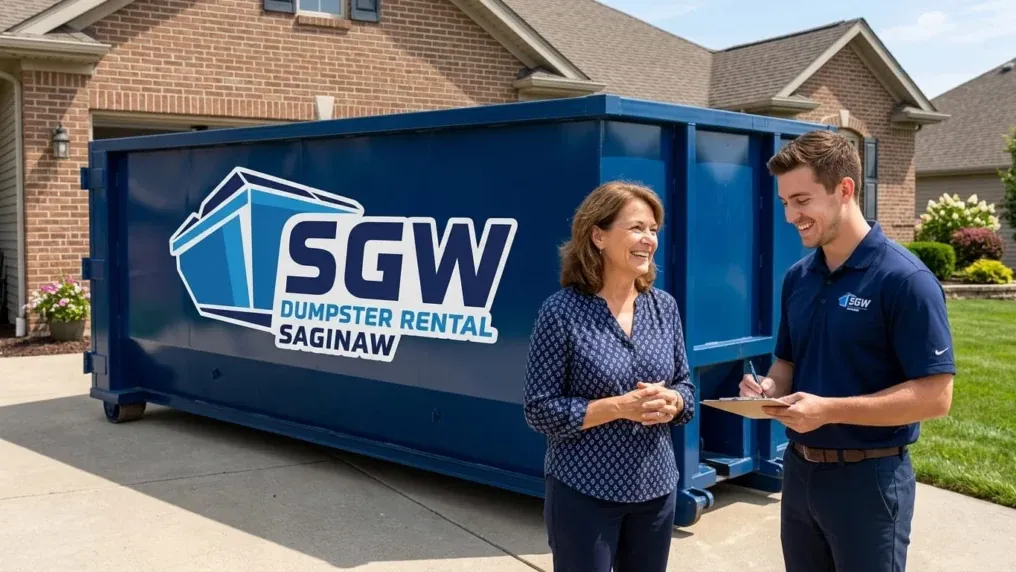
What people ask before they call
These are the questions that actually come up on the phone, grouped so you can find the one you came for. A few of them have unusually exact answers, because the City of Saginaw has written its refuse rules down and we can quote them by section. A few of them end with us telling you to call somebody else, because the rule you need belongs to a township or a fire department and we could not establish it ourselves.
Nothing here is a substitute for describing your own job down the phone. A container question is really four questions at once: what the material is, how much of it there is, where the box will stand, and how the truck reaches that spot. Two minutes on the phone settles all four, and there is no quote form, no booking screen and no account standing in the way of it.
Part 1
Sizes and what fits
Which dumpster size do most households here end up with?
The 20 yard. It is the default whole-house declutter because the contents of a house are bulky rather than dense, and three or four bedrooms of loosely loaded belongings land close to twenty cubic yards. It is also the size where neither limit dominates, so a load heavier or lighter than you expected still fits the container you booked.
Why would a heavy load go in a smaller container?
Because the limit that stops a heavy load is weight on the road, not room in the box. A loaded roll-off has to be lifted onto a truck and driven, and that fixes a ceiling that extra height does nothing to raise. Concrete, block, tile, soil and shingle reach that ceiling with plenty of empty wall above them, so they go in a 10 yard filled part way.
What size does a roof tear-off go in?
A 10, 15 or 20 depending on roof area and how many layers are coming off. Never a 30 and never a 40. Shingle is dense enough that a container reaches lawful payload while the material is still well down inside it, so the extra height on the big boxes is empty steel you have to pitch debris over for nothing.
Can I swap to a different size after the container has been delivered?
Yes. Swapping a part-filled box for a different one is routine, and it is a far smaller problem than discovering the issue when the truck arrives to collect. If you are partway through and the load is climbing faster than you expected, stop and call rather than loading above the rail.
How many kitchen bags does each size hold?
Working figures: roughly 50 to 70 bags in a 10 yard, 80 to 100 in a 15, 110 to 130 in a 20, 170 to 190 in a 30 and 230 to 250 in a 40. Those only hold for bulky household waste. The moment the load includes building material, weight becomes the limit and the bag count stops being a useful guide.
Part 2
What can and cannot go in
Can concrete, brick and soil go in a roll-off container?
Concrete, brick and soil routinely go in a roll-off container, and the honest answer is that they go in a <em>small</em> one, filled part way. A cubic yard of broken concrete is heavy enough that the box reaches the weight a loaded truck can lawfully carry on a public road while it still looks half empty, so a 10 yard is usually the right call for a load that looks like it needs a 30. Worth knowing separately: § 50.06(C) names stones, bricks, plaster, concrete, sand, gravel and earth among the material the <strong>City of Saginaw’s</strong> own collection will not pick up, which is a large part of why these loads get a container at all. What we will not do is commit to your specific load on a web page, because the answer turns on what else is going in with it. Tell us what you have and we will go through it with you.
What does Michigan ban from landfills?
The bans are item by item rather than a single list, and they are not uniform. Some items carry no stated ban at all, a couple are conditional, and the rules differ between households and businesses. That is exactly why generalizing is unhelpful. EGLE publishes the current position, and a hauler has a statutory duty to inform customers about landfill-banned wastes annually.
What about tires?
Tires are one of the conditional cases rather than a flat ban, and there is a separate wrinkle on the hauling side: Michigan requires a scrap tire hauler registration where more than ten scrap tires will be picked up. Ten is a low number on a cleanout. If tires are in the load, say how many when you call so it is dealt with up front.
Can I put paint, oil or solvents in a container?
Liquids are the clearest case of something to ask about before it goes in rather than after. For context on the City side, § 50.06(F) names liquids including oil, paints and solvents among the material the City's collection will not take, along with anything radioactive, acidic, caustic or explosive. Call and describe what you actually have.
Do you need a license to haul solid waste in Michigan?
EGLE's own position is that the solid waste regulations do not require a license, permit, or registration from EGLE to haul solid waste, with the scrap tire registration above as the exception. That matters because a phrase you will see on national pages, hauler licensing, names a credential Michigan does not actually issue. We would rather correct it than repeat it.
Part 3
The City's ordinance, and what it will not collect
What exactly does City Code § 50.06(C) say?
It names, as material not to be collected, stones, bricks, plaster, shingles, lumber, demolition materials, building materials, concrete, sand, gravel, and earth. That is the City of Saginaw's own ordinance text, and between that subsection and § 50.06(I) you have most of what a household or a contractor would ever want a container for.
What is § 50.06(I) and why does it matter on a contractor job?
It covers material resulting from contract work, with landscaping, tree trimming, construction or demolition, and work done by utility companies given as the examples. So the question is not only what the material is but how it came to be there. Debris generated by hired work falls under that subsection whatever it is made of.
What are the 35 gallons, 50 pounds and 20 bags in § 50.05?
They are the ceiling of the City's household collection. A set-out container must be 35 gallons or less, the weight of the container and its contents may not exceed 50 pounds, and each household may set out no more than 20 bags per week. The same section bars cardboard boxes, barrels, drums and paper shopping bags as set-out containers.
Does the ordinance mean I have to rent a dumpster?
No, and we will not suggest otherwise. § 50.06 states what the City's collection will not pick up. It places no obligation on you to hire anything. What you do with material the City will not take is your decision, and a container is one option among several.
What happens if building material is left in the street?
Within the City, § 94.068 deals with trash or building materials in the street right-of-way. A posted notice requires removal within 72 hours from the date of this notice, and removal costs can be assessed against the premises. It is a straightforward reason to keep a load inside the property line rather than on the apron.
How current is the Chapter 50 text quoted on this site?
Chapter 50 is current through Ordinance O-274, passed 22 September 2025 and effective 2 October 2025. We date-stamp it because codes change and a quotation without a date is worth very little. Separately, where we quote the City's collection contractor rather than the ordinance, we say so, because contractor rules change more often than code does.
Part 4
Which government your address is in
My mail says Saginaw. Am I in the City of Saginaw?
Not necessarily. Saginaw is a postal city as well as a government, and the two cover different ground. Two addresses can both read Saginaw, MI 48601 and sit in different jurisdictions. If you need to know, the township or village office for your address will tell you, and it is worth knowing before you rely on any rule you read online.
How many governments are there in Saginaw County?
Thirty county subdivisions: three cities and twenty-seven townships. On top of that, five villages sit inside their townships, so a village address has two governments over it at once. That is the real reason a single page of rules for the whole county would be wrong, and why ours stops at the City line.
Is Saginaw Charter Township part of the City of Saginaw?
No. It is a separate government, and a large one. At the 2020 Census it had 41,679 residents against the City of Saginaw's 44,202, and much of its mail reads Saginaw. The practical consequence is real: the township enforces the 2018 International Fire Code while the City enforces the 2024 edition.
Which government is your own yard in?
We could not establish it. Our address is 3102 Sawyer Dr, Saginaw, MI 48601, which is a postal address and nothing more. Public records did not settle which jurisdiction the street number falls in, so we do not claim one. It seemed better to say that out loud than to put a confident line on a page and hope nobody checked.
I live in a village. Who do I call about refuse rules?
Both. A village sits inside a township, so a village address answers to the village and to the township at the same time, and the two do not necessarily handle the same subjects. Start with the village office and ask them what they handle and what the township handles. We could not establish those rules for any village on this site.
Part 5
Placement, ground and access
How much room does the truck need in my driveway?
Think of it as the length of the box itself plus the room the truck needs to tilt it off and hook it back on, the truck's own width alongside, and a clear overhead through the full travel of the hoist arm. We do not publish a figure in feet for any of the five sizes, because the number that decides it is the one at your address and not an average one — describe the approach on the phone and we will work it out with you. The arm rises a long way before the container comes down, so a branch that clears a car clears nothing useful.
Will a container damage my driveway?
It can, and plywood is the simple defense. Put sheets under the wheels and under both rails before delivery, not after, so the point pressure is spread rather than concentrated. Soft verges, decorative borders and irrigation heads along the edge of a drive are the things most often caught, because they sit exactly where a wheel travels.
Can you tell me whether my ground will hold a loaded container?
No. We are not qualified to assess the ground at any address and we will not pretend otherwise. What we can describe is surface behavior: firm, dry ground carries a loaded container, and ground softened by a wet week or moving through freeze and thaw does not. If a surface worries you, that is a question for somebody who can stand on it.
How far from the house does the container have to sit?
We publish no separation distance, in any unit, because we could not find a sourced one for this market. The code picture is also unusual here: Michigan's statewide rule adopts NFPA 1, Uniform Fire Code, 2006 edition, and switches off wherever a local code exists, so the City runs the 2024 International Fire Code and Saginaw Charter Township runs the 2018 edition. Ask the fire department with jurisdiction.
I am digging before the container arrives. Do I need MISS DIG?
Yes, for the digging, and the Michigan numbers are not the national ones. Notice must be given at least 72 hours, but not more than 14 calendar days, before the start of any blasting or excavation. Michigan calls the area either side of the marks the caution zone and sets it at 48 inches. A ticket is valid for 21 days and can be extended to 180 if the notice says so. The notice covers the excavation itself, not where a container is set down, and within the caution zone facilities are exposed by soft excavation: hand digging, vacuum excavation or non-mechanical tools.
Part 6
How ordering works
How do I book a container?
By phone, on (989) 272-9034. There is no quote form, no booking screen and no account to create. Have four things ready: what the material is, roughly how much of it there is, where you want the box to stand, and how a truck gets to that spot. Those four answers settle the size question most of the time.
Can I get a container delivered today?
Call and ask what the board looks like today. We will not put a promise about timing on a web page, because the honest answer changes from one morning to the next, and a page cannot see the schedule. A short call gets you the real answer for the day you are asking about.
Do you carry insurance?
There is commercial cover on every load. We do not publish policy details or make any claim about regulatory standing, because those are two different things and the second one gets stretched on a lot of websites. If your site or your contract needs documentation before anything is delivered, ask on the phone and we will deal with it then.
There is a chat window on this site. Is that a booking system?
No. It is a chat widget supplied by a third party, and typing into it is not an order. There is no quote form, no booking screen and no account anywhere on this site, and nothing is confirmed until you have spoken to somebody. If you want a container, the phone number is the route.
Talk to a real person
If your question is not on this page
Call (989) 272-9034. If it is about your driveway, your load or which government your address sits under, two minutes on the phone beats any FAQ page.
Call and ask what the board looks like today
Keep reading
Guides that go deeper
- What the City of Saginaw will not collect, by section number
- Which government am I in? Thirty subdivisions and one mailing address
- 35 gallons, 50 pounds, 20 bags a week: the ceiling of City collection
- Three fire codes, seven miles apart
- Which container size do you actually need?
- MISS DIG: 72 hours, 14 days and the caution zone
- Driveway protection on Saginaw clay
Where these answers come from
Read the sources, not just us
Where an answer above quotes a rule, this is the document it came from. Where it says we could not find one, these are the places we looked.
- City of Saginaw Code of Ordinances — Chapter 50 (refuse) and Chapter 92 (fire) in full, as codified.
- Michigan EGLE — Solid waste, asbestos notification and landfill bans.
- Michigan Legislature — NREPA Part 115, PA 174 of 2013 and the MCL text.
- MISS DIG 811 — File a dig notice before any excavation.
- Saginaw Charter Township — A separate government from the City.
- Buena Vista Charter Township — Runs its own contracted building department.
- US Census QuickFacts — The population and housing figures quoted here.
- National Weather Service — Detroit/Pontiac — The NWS office covering Saginaw County.