
Saginaw County service
Concrete and Heavy Debris Dumpsters in Saginaw, MI
Dedicated containers for concrete, block, brick, tile and soil — loaded low and level, because dense material reaches the weight a truck can lawfully carry long before it fills the box.
- City ordinance quoted by section
- 17 communities, 19 governments
- Call-only — no quote form
- We say what we could not verify
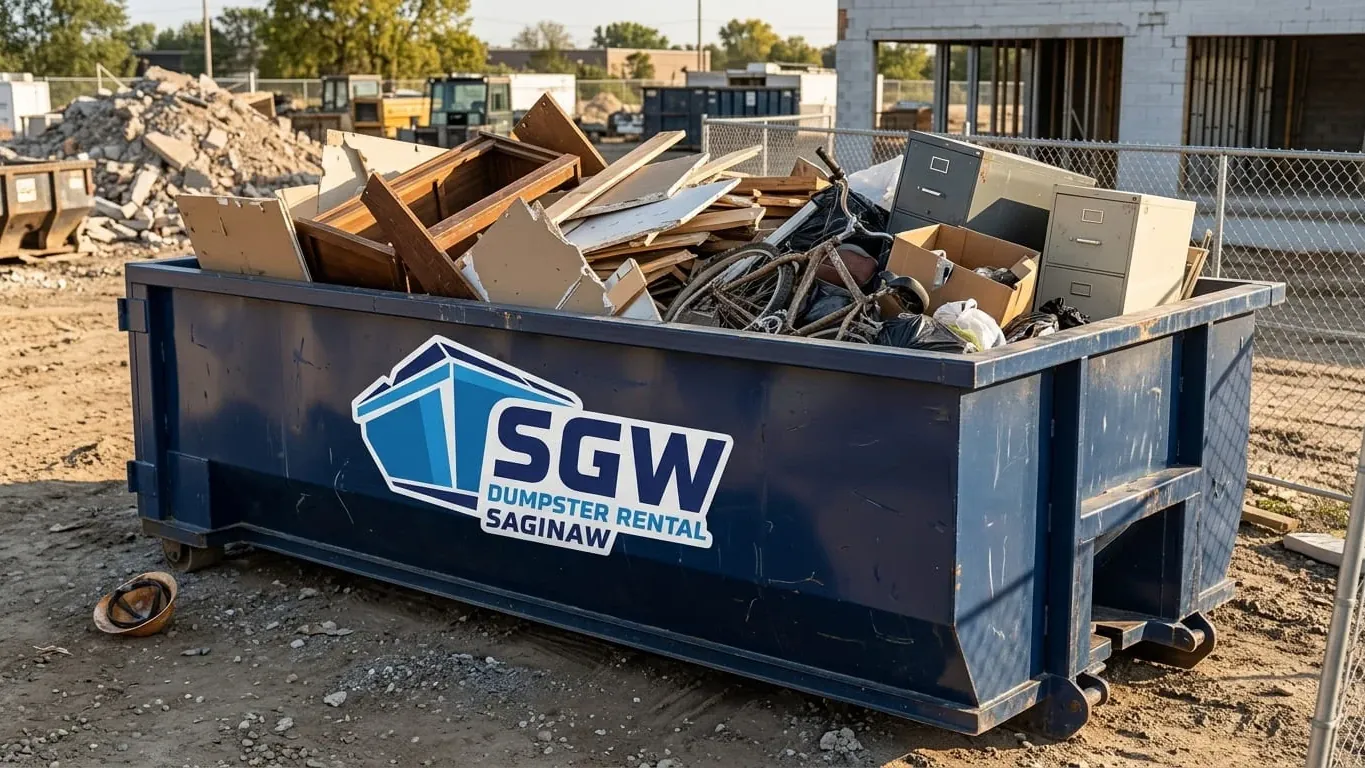
Concrete & Heavy Debris across Saginaw County
Heavy debris breaks the rule everyone brings to container sizing. For almost every other job, a bigger box holds more. For concrete, masonry and soil it does not, because the constraint is not the space inside the container — it is the weight the loaded truck can lawfully carry out on a public road. A large container filled with broken slab reaches that point while it still looks half usable, and a container that cannot be lifted is not capacity. It is a problem sitting on your driveway.
So the honest answer here is the small box, loaded flat, and swapped if the job needs more. A 10 yard is the standard concrete container and it is the one we will suggest for a driveway, a patio, a set of steps or a footing. If somebody offers you the biggest box on the lot for a slab tear-out, they are selling you air you will not be allowed to use.
The City's ordinance recognizes the same category. Section 50.06(C) says the City's collection will not take “stones, bricks, plaster, shingles, lumber, demolition materials, building materials, concrete, sand, gravel, and earth.” Concrete, sand, gravel and earth are named outright, so the curb was never the route.
At a glance
What you get with concrete & heavy debris
- The 10 yard as the standard container for concrete and masonry
- Loaded flat and level, never heaped above the top rail
- Single-material loads kept clean, because a clean load has somewhere to go
- Plywood under the wheels and both rails, on a surface walked before the set
Dense material is a weight problem, not a volume problem
A cubic yard of broken concrete, block, brick, tile, mortar or wet clay weighs a great deal more than a cubic yard of furniture, and the loaded container still has to travel a public road within what the truck can lawfully carry. That is the real ceiling on a heavy load, and it arrives early. The practical consequence is that the useful question is never “how big a box can I have” but “how much of this material can leave in one trip.”
This is why we steer heavy jobs toward the 10 yard and sometimes the 15. The box is low-sided and easy to load over, which matters when you are lifting slab by hand or wheeling it in a barrow, and it is sized so that a full box is a legal box. Two or three swaps on a large driveway tear-out is an ordinary plan and a workable one. One oversized container that has to be partly emptied by hand before it can be lifted is neither.
Load it level, from the front wall backward, with the largest flat pieces laid down rather than tipped in on edge. Nothing may sit above the top rail when the truck arrives. And if the job is going to produce more than you expected — which concrete almost always does, because a slab is thicker than it looks from above — say so early, so the swap is scheduled rather than squeezed in.
Keep it clean and keep it separate
A single-material load behaves completely differently from a mixed one. Clean broken concrete, clean brick and block, clean soil: each of those has a straightforward destination. The moment timber, plastic sheeting, insulation, carpet or general demolition waste is mixed through it, it stops being that material and becomes a mixed load with the weight of a heavy one. That is the worst combination available, and it is usually accidental.
So separate at the source, which is far easier than separating later. If the job produces both — a patio coming up along with the fence and the shed behind it — two containers used properly will serve you better than one container used badly. Tell us on the phone what the mix looks like and we will plan it with you rather than discovering it at collection.
A few specifics worth raising before loading starts. Reinforcing bar and mesh cast into a slab need to be dealt with as they come out rather than left protruding, both for safety and because projecting steel can stop a container being loaded onto the truck at all. Soil with a lot of stone in it behaves as heavy material rather than as spoil. Asphalt is not the same material as concrete and should be mentioned separately. Anything that might be contaminated — soil around a tank, anything with fuel or solvent in it — is a different conversation entirely and starts with EGLE, not with us.
What the City will not take, in its own words
Three sections of the City of Saginaw's refuse chapter land on heavy debris, and together they close the curb route completely. Section 50.06(C) names “stones, bricks, plaster, shingles, lumber, demolition materials, building materials, concrete, sand, gravel, and earth.” Section 50.06(B) excludes “small items in piles requiring a shovel or fork to handle,” which is exactly what rubble is. And Section 50.05 caps a refuse container at 35 gallons with the container and contents not exceeding 50 pounds, which no realistic bucket of concrete is going to respect.
If a contractor did the work, Section 50.06(I) catches it again as “material resulting from contract work.” And if rubble ends up in the street right-of-way next to the property rather than in a container, Section 94.068 provides for a posted weatherproof notice requiring removal “within 72 hours from the date of this notice,” with the cost of removal assessed against the premises.
Chapter 50 is current through Ordinance O-274, passed 22 September 2025 and effective 2 October 2025, and the full text is public at the City's code library. One boundary, stated plainly: those are City of Saginaw sections. For the sixteen other communities on our list we did not read a refuse ordinance, so we will not tell you what any of them say about rubble.
Suitability
When concrete & heavy debris is the right call, and when it is not
Read both columns against what is actually going to come out of the building before anything is booked. It is a short job and it decides the size.
Good fits for this container
- Driveway, sidewalk and patio slab tear-out
- Block, brick and stone from a chimney, wall or foundation
- Tile, mortar, plaster and other dense interior tear-out
- Clean soil and clay spoil from an excavation
Send these somewhere else
- Concrete mixed through general household junk or timber
- Loading above the top rail, at any size
- Soil or rubble that may be contaminated with fuel or solvent
Sizing
Container sizes that run on concrete & heavy debris
Every size below runs on this service. Choose on the density of the material and the cubic yards look after themselves, because what ends a dense load is the weight the loaded truck can lawfully carry on a public road.
- 10 yard — The standard heavy container. Concrete, block, brick, tile and soil, loaded flat and swapped if needed.
- 15 yard — Where the heavy material is mixed with a genuinely lighter component and the average density drops.
- 20 yard — Only when dense rubble is the minority of an otherwise light load, not for a slab tear-out.
| Size | Dimensions | Capacity | What fills it first | Best for |
|---|---|---|---|---|
| 10 Yard Dumpster | about 14 ft long × 7.5 ft wide × 3.5 ft high | about 50-70 kitchen-size trash bags | Weight, with the box still half empty | Concrete, block, tile, dirt and roof tear-off. |
| 15 Yard Dumpster | about 16 ft long × 7.5 ft wide × 4.5 ft high | about 80-100 kitchen-size trash bags | Usually weight, on a mixed load | Garage clearing, flooring tear-out and one heavy room. |
| 20 Yard Dumpster | about 22 ft long × 7.5 ft wide × 4.5 ft high | about 110-130 kitchen-size trash bags | Either, depending what goes in | Most remodels, and a house being emptied room by room. |
| 30 Yard Dumpster | about 22 ft long × 7.5 ft wide × 6 ft high | about 170-190 kitchen-size trash bags | Volume, on bulky light material | Multi-room work and a full estate clearance. |
| 40 Yard Dumpster | about 22 ft long × 7.5 ft wide × 8 ft high | about 230-250 kitchen-size trash bags | Volume, almost always | New construction and bulky demolition waste. |
Concrete & Heavy Debris in Saginaw County: the local specifics
Ground conditions matter more for a heavy container than for any other kind, and Saginaw's are distinctive. The city sits on the flat lake plain of a former glacial lake, in the USDA's Erie-Huron Lake Plain region, and the soils through the area include heavy clay that drains slowly. We publish no numbers about it — no bearing value, no frost depth, no water table — because we have no source we are willing to stand behind for any of them.
What we will say is about the surface, and it is the part you can see. Firm, dry ground carries a loaded container; ground that has taken a wet week or is cycling through freeze and thaw does not behave the same way, and a heavy load is where that difference shows first. Plywood goes under the wheels and under both rails as a matter of course, and the driver walks the approach before the box comes off the truck. We are not qualified to assess the ground at any address, so tell us what the drive is like and we will plan the set rather than find out the hard way.
Talk to a real person
Concrete & Heavy Debris across Saginaw County, one call away
One short call does it. Describe the material and the access, and name the community the address sits in — the City of Saginaw is the one jurisdiction on our list whose refuse ordinance we were able to read and quote by section, and we will tell you plainly when yours is not it. Call (989) 272-9034.
Call and ask what the board looks like today
Answers
Concrete & Heavy Debris — your questions answered
Why is a 10 yard the right size for concrete?
Because the limit on a heavy load is the weight the loaded truck can lawfully carry on the road, not the space in the box. A 10 yard filled flat with broken concrete is close to that limit already. A larger container would simply be unusable space above a load that cannot get any heavier, and in the worst case a box that cannot be lifted at all.
Can I mix soil and broken concrete in one container?
Tell us first, because it changes the plan. Clean single-material loads have straightforward destinations and mixed ones do not. Soil with a lot of stone in it behaves as heavy material rather than spoil, and asphalt is a different material from concrete and should be mentioned separately. Describe the actual mix on the phone and we will size and route it properly.
Does reinforcing bar in the concrete cause a problem?
It can. Rebar and mesh should be dealt with as the slab comes up rather than left protruding from the load, both because projecting steel is a hazard for anyone working around the container and because it can prevent the box being loaded onto the truck. Cut it back flush with the material and mention it when you call.
Will the City of Saginaw take broken concrete at the curb?
Section 50.06(C) names stones, bricks, concrete, sand, gravel and earth among the materials the City's collection will not pick up, and Section 50.06(B) separately excludes small items in piles requiring a shovel or fork to handle. Section 50.05 also caps a refuse container and its contents at 50 pounds. The curb was never a route for rubble, and the ordinance says so in three places.
How high can I load a heavy debris container?
Level with the top rail and no higher, at any size. Load from the front wall backward with the largest flat pieces laid down rather than tipped in on edge, which both keeps the surface even and makes better use of the floor. If the material is going to overrun the box, call for a swap rather than heaping it, because an overloaded container simply will not be collected.
Service area
Concrete & Heavy Debris across Saginaw County
We run containers out of 3102 Sawyer Dr to seventeen communities in Saginaw County. They are grouped below by what kind of government each one actually is, because in Michigan that is the difference between a city hall, a township board and a village that sits inside a township — and it decides who you have to call about your own address. If yours is not listed, call anyway; we most likely still get there.
The city
The only jurisdiction in this list whose refuse rules we were able to read and quote.
Townships
A township board, not a city hall. We could not establish container or refuse rules for any of these, and we do not publish ones we could not read.
- Buena Vista TownshipCharter Township
- Carrollton Township2.5 mi straight-line
- Kochville Township5.6 mi straight-line
- Saginaw TownshipCharter Township
- Blumfield Township7.0 mi straight-line
- Bridgeport TownshipCharter Township
- Spaulding Township9.7 mi straight-line
- James Township10.7 mi straight-line
- Thomas Township11.4 mi straight-line
- Tittabawassee Township11.8 mi straight-line
- Taymouth Township13.8 mi straight-line
- Swan Creek Township14.3 mi straight-line
Other incorporated places
Two cities and two villages. A village sits inside its township, so a village address has two governments over it at once.