Most people planning a demolition think about the container, the machine and the dump. The thing that actually trips jobs up in Michigan is a form.
Michigan’s asbestos notification rules are not shaped the way almost anyone expects. The headline fact is this: a demolition is notifiable even when there is no asbestos in the building at all. Not notifiable if asbestos is found. Notifiable, full stop, with a clock on it. And the residential exemption that people reach for — “it’s just a house, we’re fine” — is bounded in three separate ways, one of which has nothing to do with the building and everything to do with who is driving the project.
This article sets out what we were able to read in the federal and state program material, says plainly where we could not establish something, and gives you the phone number of the inspector who covers Saginaw County. It is background for planning a job. It is not advice about your particular building, and it is not us offering to handle asbestos.
First, the two agencies — and neither of them is LARA
This is where out-of-state templates and half-remembered advice go wrong immediately. Asbestos in Michigan is split between two departments:
- EGLE — the Department of Environment, Great Lakes, and Energy, through its Air Quality Division, runs the asbestos NESHAP program in Michigan. It collects the fees, reviews notifications of intent to renovate or demolish, and inspects removal and demolition projects. Notifications are submitted through EGLE’s MiEnviro Portal.
- LEO — the Department of Labor and Economic Opportunity, through MIOSHA, handles the worker-safety side.
Two notes on names. EGLE was previously the Department of Environmental Quality, and plenty of older documents and live state web addresses still carry the old initials. The agency today is EGLE. And MIOSHA sits under LEO, not under LARA — LARA is the department that handles construction codes and the Bureau of Fire Services. Send an asbestos question to LARA and you have sent it to the wrong building.
The notification form is a joint one. EGLE’s own fact sheet refers to the inspecting contractor having to be listed on the joint EGLE/LEO notification form, and EGLE’s published fee schedule distinguishes notifications submitted as EGLE only, as both EGLE and LEO, and as LEO only. So it is one form serving two agencies, with different fee treatment depending on which of them it is going to.
The rule that catches people: a demolition is notifiable with no asbestos
EGLE’s fact sheet on understanding the asbestos NESHAP lists, among the things the notification requirement applies to, “Demolition activities below the thresholds (even for facilities with no asbestos).”
Read that against the thresholds in the next section and the structure becomes clear. The square-footage and linear-footage thresholds govern renovation. A demolition is notifiable regardless of how little regulated material is present — including none.
That is the opposite of how the duty is usually described in conversation, which tends to run: get it tested, and if it comes back clean you are clear. Testing is its own requirement, covered below. The notification is a separate duty with its own clock, and “it came back clean” does not remove it for a demolition.
The thresholds that do govern renovation
For renovation work, the thresholds are stated on the amount of regulated asbestos-containing material — RACM — involved:
- Pipes: “80 linear meters (260 linear feet)”
- Other facility components: “15 square meters (160 square feet)”
- Material already off the facility components, where the length or area could not be measured beforehand: “1 cubic meter (35 cubic feet)”
Those are small numbers in practice. One hundred and sixty square feet is a modest run of ceiling, a boiler room, a stretch of old flooring and the mastic under it. If you are gutting a building rather than knocking it down, this is the measurement that decides whether you are notifying.
The residential exemption, and the three places it stops
Here is the exemption, in the words of EGLE’s fact sheet. It covers “residential buildings having four or fewer dwelling units that are under private control or ownership.”
Three limits are built into that one sentence, and every one of them is a live question on real jobs:
- Four or fewer dwelling units. A five-unit building is covered. A duplex, a triplex, a four-flat are within the exemption on the unit count; the next one up is not. This is a counting exercise, not a judgment call.
- Under private control or ownership. The exemption is written around private control. A building that has come into public hands is a different case.
- Not for urban renewal, and not part of a public or commercial project. The fact sheet lists as not subject privately owned homes that are not being demolished for urban renewal or as part of a public or commercial project. So the exemption falls away where the demolition is publicly driven or forms part of a commercial undertaking — even though the building itself is a house.
And one inclusion that surprises nearly everyone: residential dwellings intentionally burned for fire training are covered. A donated house used for a burn exercise is not sitting in the residential exemption.
The sentence to never write, and never believe, is “houses are exempt from asbestos rules in Michigan.” They are exempt within four units, under private control or ownership, and outside publicly or commercially driven demolition. Three conditions, all of which have to hold.
Why that third condition matters here specifically
Publicly driven demolition is a documented activity in this county, which is simply a fact about where the exemption’s edge sits locally.
The Saginaw County Land Bank Authority exists under the Michigan Land Bank Fast Track Act, 2003 PA 258, MCL 124.751 to 124.774, and was set up through an intergovernmental agreement between the state authority and the County Treasurer, with member appointments running from an effective date of 6 January 2006. The County Treasurer chairs it by virtue of office. Its board seats are defined by constituency, and one of them is held by a resident of Buena Vista Township.
Michigan’s State Land Bank Authority publishes a table of its program awards. That table records two awards to the Saginaw County Land Bank Authority: $200,000, awarded 20 March 2023, and $2,500,000, awarded 1 September 2023. Statewide, the State Land Bank Authority states it has removed more than 3,300 structures since 2010. We are not publishing a local structure count, because we did not find one.
We state all of that as public information and nothing more. We are describing where a federal exemption stops, not any relationship between this business and any government body. If you are working on a project with a public element, the asbestos question is one to settle early rather than at the end, because the exemption you might have relied on for a single-family house may not be available.
The inspection comes before the work, not during it
EGLE’s fact sheet is direct about this: “The Asbestos NESHAP requires that a thorough inspection be conducted for all renovations and all demolitions.”
Three operative details sit under that sentence. Inspections must be completed before work starts. The inspecting contractor must be listed on the joint EGLE/LEO notification form, which means the inspection has to be arranged before the notification is filed, not after. And visual-only inspections are not acceptable, unless the building is primarily steel and concrete or is otherwise unlikely to contain asbestos.
Sequence, then: inspect, notify, wait out the clock, demolish. Anyone building a schedule in the other order is building it wrong.
Ten working days, $100, and the thing that voids a notification
The notice periods, as published:
- Renovation and demolition: notify EGLE’s Air Quality Division through the MiEnviro Portal at least ten working days before work begins.
- Non-scheduled renovations may be covered by an annual notice, submitted ten working days before the start of the calendar year.
- Ordered demolitions and emergency renovations: notify no later than the following work day.
The fee comes from statute. EGLE’s published asbestos fee schedule states that “MCL 324.5519(3) requires a $100 fee for each original submitted Notification”, with $10 for a revision. That is the same for an EGLE-only notification and for one going to both EGLE and LEO; a LEO-only notification is not charged the $100 or $10 submittal fee, and fees owed to MIOSHA are not paid through MiEnviro. The schedule we read was dated April 2025, and it records that revisions to notifications submitted before 2 April 2025 are not charged a fee. All fees are non-refundable.
Then the line that deserves to be on a planning checklist in bold: “If the fee is not paid, the Notification and/or the revision to the Notification is not considered submitted.”
Put that next to a ten-working-day clock and the scheduling risk is obvious. An unpaid fee does not produce a late notification — it produces no notification, which means the clock never started. Ten working days is also two calendar weeks on a good run, and longer across a holiday.
The desk that answers for Saginaw County
EGLE’s own asbestos landing material notes that contact information for the asbestos NESHAP program varies by geographic region and county, so a generic state number is the wrong answer to a county-specific question. From EGLE’s published asbestos program contact list:
- Saginaw County asbestos NESHAP inspector: Steve Kidder, 517-243-4492, KidderS@Michigan.gov, listed under Asbestos NESHAP Inspectors, EGLE Air Quality Division, Field Operations.
- EGLE Environmental Assistance Center: 800-662-9278 — the general program line, and the number printed on the fact sheets.
Start with the county inspector. That is the person whose area your job sits in. Program material and contact lists are revised periodically, so confirm before you rely on a number you read anywhere, including here.
What we could not establish about permits — and why we are telling you
We looked for the City of Saginaw’s demolition permit requirements and fees and we could not find them.
That is a genuine gap with a specific cause. The City’s own website is closed to automated reading on every path except its homepage. The City’s code of ordinances is published in full by its codifier, and we read a good deal of it — but the chapter-level pages for building regulations and property maintenance render as headings with no text, so the sections that would carry a wrecking or demolition permit provision were not readable to us. We also checked the state’s jurisdiction list for who enforces which construction code where, and the extractable text of that document stops alphabetically before Saginaw County.
So: we are not telling you a demolition permit is required, and we are not telling you one is not. We do not know, and a dumpster company guessing at a permit requirement is how people end up with a stop-work order. Call the City of Saginaw at (989) 399-1311 and ask. If the job is in a township, ask that township — and bear in mind that township building functions in this area are often contracted out to private firms, so the office you need may be an extension number rather than a department.
The same restraint applies to fee amounts. We publish none, for any jurisdiction, because we verified none.
Then there is the debris itself
Set the asbestos question aside and a demolition still generates a pile that municipal collection in the City of Saginaw will not take. That is not a sales line; it is the City’s own ordinance.
City Code § 50.06 lists materials not to be collected. Subsection (C) names “Stones, bricks, plaster, shingles, lumber, demolition materials, building materials, concrete, sand, gravel, and earth.” Subsection (I) names “Material resulting from contract work”, with examples given as “landscaping, tree trimming, construction or demolition, or work done by utility companies.”
Between those two subsections, essentially everything a demolition produces is outside the City’s collection service. The ordinance does not require you to rent anything — it states what the City will not pick up, and what you do about that is your decision. Note also that § 50.06 does not mention appliances, stumps or bulky items; we are not going to tell you it does.
And if the debris sits out front while you decide: § 94.068 deals with trash, abandoned property or building materials on the street right-of-way next to a property. An enforcement officer posts a weatherproof notice of at least 8 by 10 inches stating that the material is improperly stored and “must be removed within 72 hours from the date of this notice”, mails a copy to the property owner per City Assessor records, and after 72 hours may cause the trash to be removed, with the City’s removal costs assessed and levied against the premises.
All three of those are City of Saginaw provisions. They are not county rules and they are not township rules. The City’s code was marked current through Ordinance O-274, effective 2 October 2025, when we read it. For the other twenty-nine county subdivisions we established no refuse ordinance at all, and we are not going to invent one.
Containers for the clean part
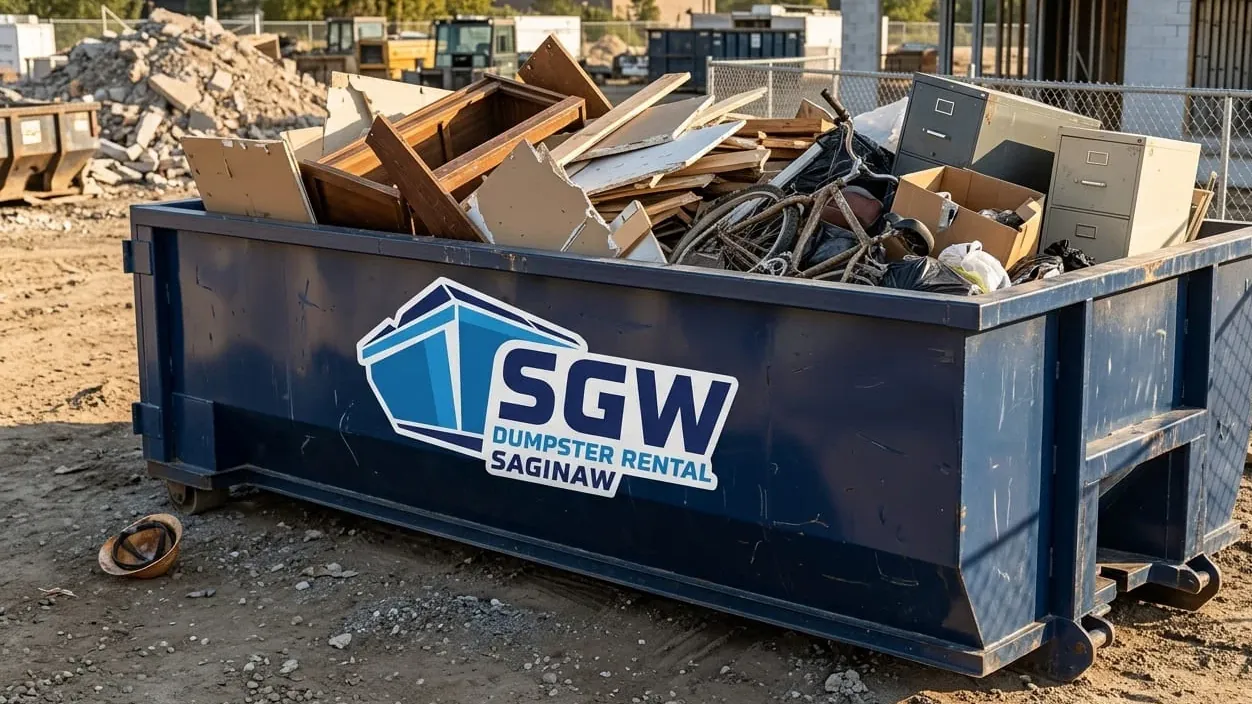
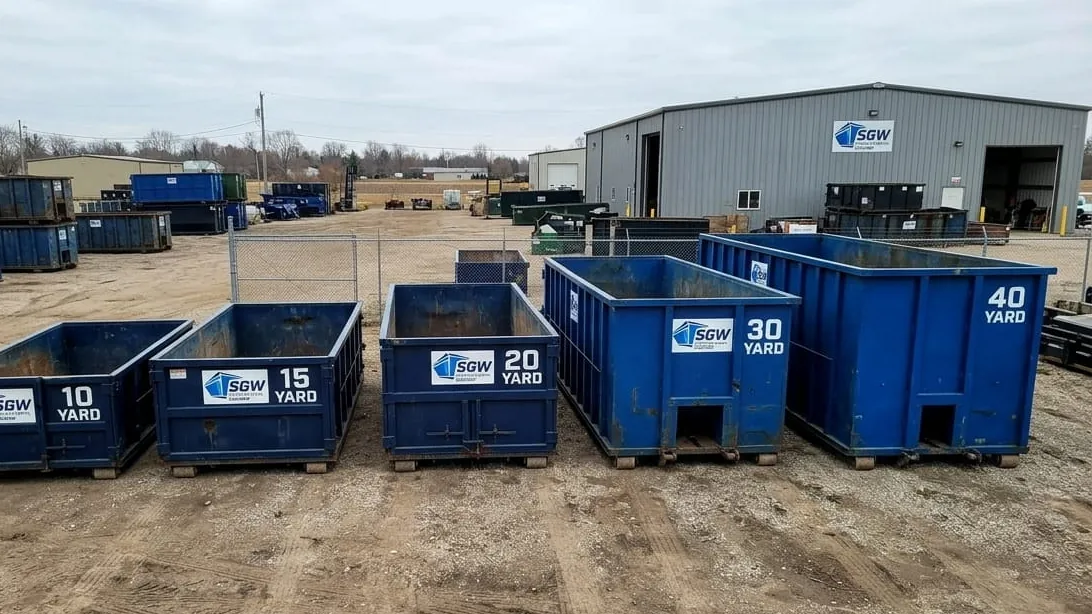
What a container is for, on a job like this, is the material that is simply heavy rubble and framing. Mixed demolition debris is dense, so the usable question is rarely “how big” but “how heavy before it has to go.” Brick, plaster, concrete and wet timber reach lawful road weight well before they fill a large box, which is why the right answer on a demolition is often a smaller container swapped more often rather than the biggest one on the list.
Call (989) 272-9034 and describe the structure, the material and where a truck can get in. There is no quote form, no booking screen and no account — the phone is the whole system. We are not in a position to tell you whether your building needs a notification, and we will not pretend otherwise; that call goes to EGLE.
More on this site: demolition debris, concrete and heavy debris, construction dumpster rental, and the sizes most often used on a tear-down, the 10 yard and 20 yard. Related reading: what the City of Saginaw will not collect, three fire codes, seven miles apart and which government am I in? Outbound: Michigan EGLE, Michigan LEO, US EPA.