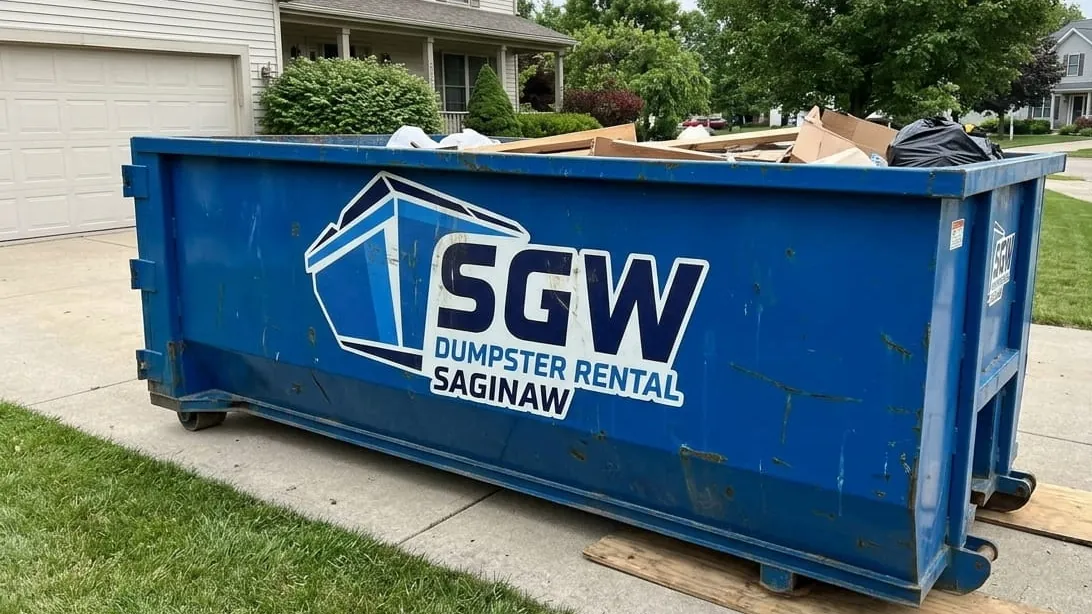
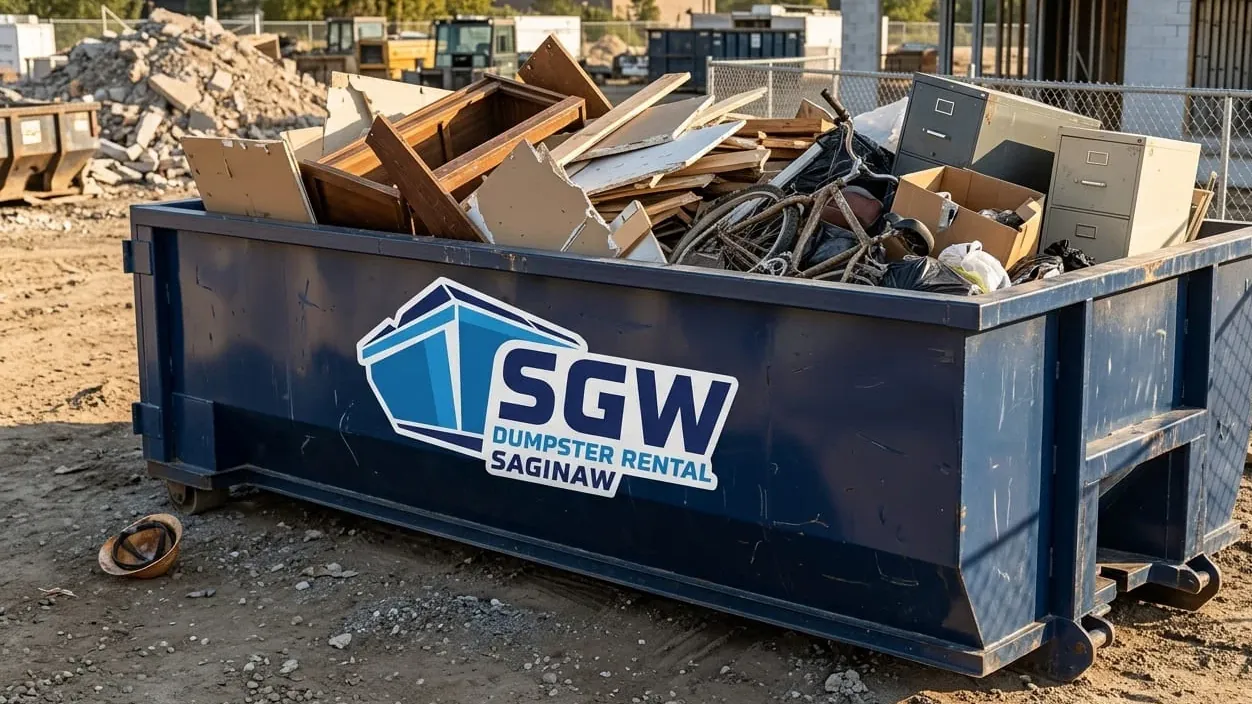
A loaded roll-off container is one of the heaviest things that will ever sit on a residential driveway, and it does not sit on it evenly. It rests on a set of small wheels and two long steel rails, which means the load arrives at the surface as lines and points rather than as a spread-out weight. Then the truck that brought it drags it off again when it is full.
That is the whole engineering problem in two sentences, and this article is about managing it on the ground we actually have around here.
It is also an article with a large hole in it on purpose. There are four numbers you might expect to find on a page like this — a soil bearing capacity, a frost depth, a water-table depth and a flood-zone determination — and none of them appears here. We will explain exactly why, because the explanation is more useful than the numbers would have been.
What the ground here actually is
Saginaw sits on a lake plain — the bed of a glacial lake that was once much larger than the water bodies in the region today.
Two authoritative framings of it. The United States Department of Agriculture’s Natural Resources Conservation Service puts this area in MLRA 099X, the “Erie-Huron Lake Plain”, and one of its ecological site descriptions states that “The Saginaw Bay and Lake Huron lake plains is coextensive with EPA ecoregion 57e (Saginaw Lake Plain).” The landform is given, in the same material, simply as “Lake plain.”
Separately, and this is an academic source rather than a government one, a Michigan State University geography page on the state’s glacial lake plains observes that “Glacial lake plains are generally flat” and that “These lands have areas of heavy clay interspersed with stretches of water-washed sand and gravel.” We attribute that characterization to the university because that is where we read it.
So: flat, clay-rich, and poorly drained — with sand and gravel streaks running through it. Note the word interspersed. The ground is not uniform. Two driveways on the same block can behave differently, and one driveway can behave differently at the apron than it does at the garage.
That is as far as the sourcing goes, and it is the whole basis for everything practical below.
The four numbers that are not on this page
We want to be specific about this, because it is the difference between a page you can rely on and a page that sounds confident.
- No soil bearing capacity. We have no primary source giving one for Saginaw. Not a figure, not a range, not a “typically.” So there is none here.
- No frost depth, and no minimum footing depth. We did find a figure. It sits in a table reproduced by a secondary republisher of Michigan’s administrative code, the table’s data row came through garbled, the column assignment had to be inferred — and the table’s own footnote says that the jurisdiction fills in the frost line column. There was no county or regional breakdown and nothing on the page tied the figure to Saginaw County. A figure like that is not a fact; it is a blank space with a sample entry in it. We are not publishing it.
- No water-table depth. The one water-table figure we came across describes a well-drained topographic high over limestone, which is close to the opposite of a heavy-clay lake plain. Carrying it across to Saginaw would be an affirmative error rather than a gap, so we did not.
- No flood-zone determination for any address. We did not investigate current flood mapping, and we are not going to characterize anyone’s property.
And the sentence that follows from all four: we are not qualified to assess the ground at any address, and this page says so. Nobody standing in a driveway with a clipboard can tell you what is two feet down, and a dumpster company that claims otherwise is selling you a feeling.
What we do have is the behavior of the surface, which is observable, and which is the part that actually determines whether a container damages a driveway.
Surface behavior: the only honest version of the rule
It comes down to one sentence. Firm, dry ground carries a loaded container. Ground that has been softened by a wet week, or that is moving through freeze and thaw, does not.
Both halves of that are things you can check without any soil data at all.
Wet. Clay-rich ground holds water rather than letting it through, and the surface above it goes from firm to plastic over a few days of rain rather than a few hours. The practical test is not whether it is raining today. It is whether the last week has been wet. Walk the spot. If your heel leaves a print, a wheel will leave more than a print.
Freezing and thawing. This is the one people underestimate, and it is not about how cold it gets. It is about how often the ground crosses the line. At the station the National Weather Service labels simply “SAGINAW,” the 1991 to 2020 monthly normals show that January and February are the only two months whose average high is below freezing, at 29.5 and 31.8 degrees Fahrenheit. The two months either side of them are where the ground actually crosses the line in both directions. December pairs an average high of 34.7 with an average low of 23.1, and March pairs 42.3 with 25.7 — a thaw in the daytime and a hard freeze at night. November is marginal rather than clear-cut, with an average low of 31.8, and April’s average low of 36.1 sits above freezing altogether, so the crossing season on these figures is December and March rather than a six-month run.
Ground that is frozen solid is firm. Ground that is thawing from the top down is soft on top and holding water underneath it, with nowhere for the water to go. That is the worst condition for setting anything heavy down, and in this climate it is a condition that recurs repeatedly across the back half of winter and into spring rather than once a year.
And wet is a year-round question, not a spring one. From the same set of normals, August is the wettest month, at 3.85 inches, ahead of May at 3.41 and June at 3.28. The driest months are February at 1.77 and December at 1.85. So the intuitive model — wet spring, dry summer — is not what the normals say. A late-August week can leave ground every bit as soft as April.
Those are normals for one station, from the local forecast office at weather.gov/dtx, and normals are not a forecast. Use them to understand the pattern, then look out of the window.
Plywood, and where it actually goes
The single most effective thing anyone does about this takes five minutes and no special equipment, and on our deliveries it is already in the truck.
Put plywood under the wheels and under both rails. Not one sheet in the middle. The load is concentrated along the rails and at the wheels, and those are the four places that will mark a surface. Spreading the load over a sheet turns a line into an area.
A few points of detail that matter more than they sound:
- Cover the path, not just the parking spot. A container is dragged on and off the truck. The damage people actually complain about is usually a scrape or a gouge along the line the rails travelled, not a dent where the box sat.
- Keep the sheets flat and together. A sheet that rides up or slides out from under a rail part way through the lift does nothing, and can do harm.
- Think about the apron. The transition from street to driveway is where a truck’s weight concentrates while it is articulating, and on a clay-based subgrade the apron is often the softest part of the whole approach.
- Asphalt in hot weather is its own case. Asphalt softens as it warms. The same driveway that carries a load in May will mark more easily on a hot August afternoon, and the marks tend to be impressions rather than cracks.
- Stamped, decorative, paver and sealed surfaces are worth a conversation before delivery rather than after. So are heated driveways, which have something in them you do not want to find with a rail.
Plywood is not a guarantee and we are not going to present it as one. It is a straightforward way to change how the load meets the surface, and it is what we would do on our own driveway.
Choosing the spot
Run through this before the truck is booked, not while it is idling at the curb.
- Firm and level, or as close as the property gets. A side slope puts the whole load on one rail.
- A straight approach with room to back in. A roll-off is delivered and collected in line with the truck; it cannot be placed sideways into a gap.
- Vertical clearance. The box goes up before it comes down. Branches, power and service drops, porch overhangs, basketball hoops and carport roofs all rule a spot out.
- What is under it. Septic fields and tanks, well heads, buried cisterns, drain tile, lawn irrigation, invisible-fence wire and landscape lighting are all things a loaded box or a truck tire finds the hard way. If the job itself involves digging, the dig notice is a separate statutory duty with a clock on it — see the 72-hour rule and the caution zone.
- What is next to it. Gas meters, AC condensers, downspouts, window wells, low sills, and the neighbor’s fence.
- Grass is a judgment call. A lawn placement spares the driveway and can look dreadful afterwards, particularly on clay ground after rain. If the lawn is the plan, plywood matters more there than anywhere.
- Mark the spot. A cone, a stake, a bucket, anything. A driver guessing from a text message is a driver putting a container somewhere you did not mean.
If it has to go in the street
Then the question stops being about your driveway and starts being about whose road it is, and that answer is genuinely three-way in this market.
A road here belongs to one of three authorities. The state, through MDOT, for state trunklines. The Saginaw County Road Commission, which reports 1,853 miles of road under its jurisdiction — 506 miles primary and 1,347 local — across 27 townships. Or the city or village whose street it is. Which one governs a given curb determines who you ask about putting anything in it, and we are not going to publish a list of which numbered routes are which, because we did not verify any route’s jurisdiction.
On the City of Saginaw specifically, here is the honest position. We could not establish whether the City requires a permit for a container in a City street, or who would issue one. We read the provision whose title looks exactly right — street occupancy — and it turns out to govern a utility franchise grantee rather than container placement. We read the general provision on obstructing a public passage or place, which prohibits purposely or recklessly obstructing one unless the person has legal privilege to do so, and which contains no permit mechanism we could find and leaves “legal privilege” undefined. The City’s own website is closed to automated reading on every path but its homepage.
So we are not telling you a permit is required and we are not telling you one is not. Call the City of Saginaw at (989) 399-1311 and ask before you plan a street placement. If the address is in a township, ask the township — and note that we established nothing at all about right-of-way permits for any township in the county.
There is one City provision we did read that bears on leaving material in the right-of-way: § 94.068 provides for a posted, weatherproof notice of at least 8 by 10 inches where an officer finds trash, abandoned property or building materials on the street right-of-way next to a property, stating that the material “must be removed within 72 hours from the date of this notice”, with the City’s removal costs after that assessed and levied against the premises. That is about loose material, not about a container, and it is a City provision only.
Your address and ours
Which government you are in is not a detail on this page, it is the whole of the street question — and in this county a mailing address does not answer it. Two addresses both reading “Saginaw, MI 48601” land in two different governments: 1315 S Washington Ave resolves to Saginaw city in the Census Bureau’s layers, and 3945 E Holland Ave, same ZIP, resolves to Buena Vista charter township and to no incorporated place at all. The county has thirty county subdivisions — three cities, twenty-seven townships — plus five villages sitting inside their townships.
Our own address is 3102 Sawyer Dr, Saginaw, MI 48601. That is a postal address. Like a great many addresses that read “Saginaw,” it may or may not sit inside the City of Saginaw — we have not been able to establish it from public records, and we are not going to guess on our own behalf any more than we would on yours. Same discipline as the frost depth we did not publish.
What to tell us when you call
Call (989) 272-9034. Locally owned and operated, call-only — there is no quote form, no booking screen and no account. On placement, the useful things to say are:
- the surface: concrete, asphalt, pavers, gravel, grass, or a mix along the approach;
- anything decorative, stamped, sealed, newly poured or heated;
- how the week has been for rain, and whether the ground has been through a thaw;
- what is overhead and what is buried;
- whether a street placement is the only option, and what the City or township told you if you have already asked;
- anything you already know about how the surface has behaved under a heavy vehicle before. The plywood is not a decision you have to make: it goes under the wheels and both rails as standard, on every delivery, and we bring it.
If the ground sounds marginal we will say so. What we will not do is tell you your driveway will be fine, because we are not in a position to know that.
Related: the permit question, which government am I in? and roof tear-off sizing. Services: residential dumpster rental, roll-off dumpster rental and concrete and heavy debris. Sizes: 10 yard, 20 yard, 30 yard.