
10 cubic yards
10 Yard Dumpster Rental in Saginaw, MI
The small box is the heavy box. When the pile is concrete, block, tile, dirt or shingle, this is the container that keeps the lift lawful.
- City ordinance quoted by section
- 17 communities, 19 governments
- Call-only — no quote form
- We say what we could not verify
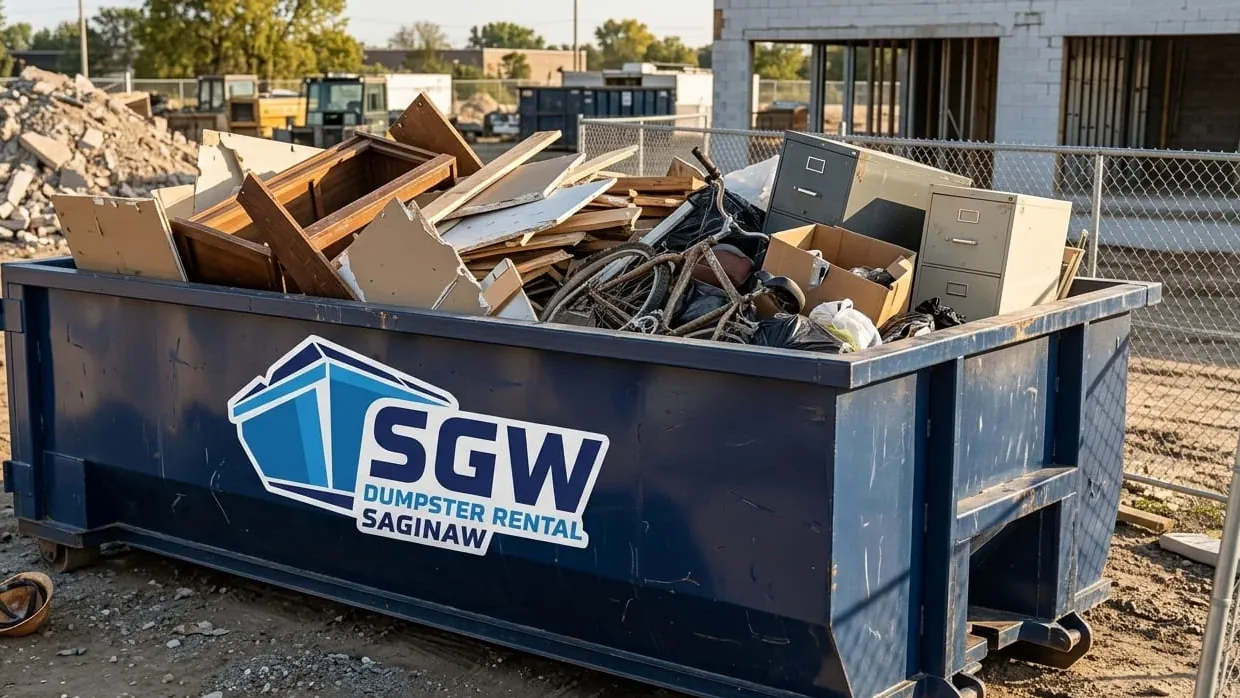
- Dimensionsabout 14 ft long × 7.5 ft wide × 3.5 ft high
- Holdsabout 50-70 kitchen-size trash bags
- What fills it firstWeight, with the box still half empty
- Space neededThe 14 foot box, plus the room the truck needs to set it down and lift it away again, plus enough width alongside for the truck itself and nothing overhead where the arm works. That is a working guide rather than a measured specification, and we would rather confirm it for your own approach on the phone than publish a figure for an average driveway.
The 10 yard container in Saginaw County, MI
A 10 yard roll-off runs about 14 feet long, 7.5 feet wide and 3.5 feet high. On volume alone that reads like a starter container. It is not. It is the box you want the moment the material is dense rather than bulky, because a truck has a lawful payload and heavy debris arrives at that payload with daylight still showing above the load.
Concrete, block, brick, tile, sand, gravel and earth all behave that way, and so does an asphalt shingle tear-off. Every one of those materials also appears, word for word, on the City of Saginaw's list of what its own collection will not pick up. City Code § 50.06(C) names stones, bricks, plaster, shingles, lumber, demolition materials, building materials, concrete, sand, gravel, and earth. The ordinance is not telling anyone to rent a container. It is telling you the cart at the curb is not the route for that pile, and it says so in a section you can read yourself.
That is the City. Outside the City line the rules belong to whichever township or village your address actually sits in, and we do not publish rules we have not read. Describe the material on the phone and we will tell you plainly whether the small box is the honest answer.
Why the smallest container takes the heaviest load
Two separate limits govern a roll-off. One is the space inside it, measured in cubic yards. The other is what the loaded container weighs when the truck picks it up, which is a matter of law on the road rather than a matter of preference. Light material runs out of space. Dense material runs out of weight, and it does so early.
A 10 yard box is built around that second limit. Its walls are low on purpose, so that a load of rubble filled to the brim is still something that can be lifted and driven. Put the same rubble in a tall container and the useful depth is the same, only now there are four feet of empty steel above it and the container is harder to place. The small box is not a smaller service. It is the right geometry for the job.
Where municipal service stops, in three numbers
City Code § 50.05 sets the ceiling on what the City's collection is built to take from a household. Containers must be 35 gallons or less. The weight of the container and its contents may not exceed 50 pounds. And each household may set out no more than 20 bags per week. The same section bans cardboard boxes, barrels, drums and paper shopping bags as set-out containers outright.
Those three numbers are not an argument against the City. They are a description of a weekly household service doing what it was designed to do. A broken patio does not fit inside them, and neither does a tear-off. Chapter 50 is current through Ordinance O-274, passed 22 September 2025 and effective 2 October 2025, so that is the text these numbers come from.
Loading dense material so the container can be lifted
Spread heavy debris along the floor of the container instead of heaping it over the axle end. A load that sits level is easier to secure, easier to lift square and less likely to shift on the way out. Keep rubble below the top rail: nothing may ride above the rail, and on a 10 yard that rail is low enough that the rule is usually met long before you reach it anyway.
Keep dirt and masonry separate from bagged household waste if you can. A clean load of one material is simpler at every stage, and it means the pile you describe on the phone is the pile that turns up. If you are partway through and the box is reaching its limit, stop and call. Swapping a part-filled heavy box for a fresh one is routine work.
Capacity
What actually fits in a 10 yard container
Working figures rather than specifications. On a dense load it is the weight the loaded truck can lawfully carry on a public road that ends the job, not the top rail.
| Material | How much fits |
|---|---|
| Concrete, block or brick | Part of the box only. Broken slab reaches lawful payload with a good deal of wall still empty above it. |
| Roof tear-off | A modest single-layer asphalt shingle strip. Shingles are dense, so the limit arrives early and the box never looks full. |
| Soil, sand or gravel | A shallow layer across the floor of the container rather than a heaped load. |
| Bagged household waste | Roughly 50 to 70 kitchen-size bags, if you were filling it on volume instead. |
Suitability
Where the 10 yard fits, and where it does not
Choose the 10 yard for
- Breaking out a concrete patio, slab, sidewalk or set of front steps
- A bathroom strip-out, where tile, backer board and an old cast tub carry most of the weight
- A single-layer asphalt shingle tear-off on a small roof or a garage
- Soil, sand or gravel coming out of a landscaping dig
Pick a different size for
- A whole-house declutter, which runs out of room long before it runs out of weight
- Bulky light debris such as cabinetry, insulation, packaging and old furniture
- A multi-room renovation mixing framing, drywall, trim and fittings
Setting a 10 yard container down in Saginaw County
Inside the City of Saginaw, the 10 yard container has an unusually exact job description, because the City has written down what it will not collect. § 50.06(C) covers stones, bricks, plaster, shingles, lumber, demolition materials, building materials, concrete, sand, gravel, and earth, and § 50.06(I) covers material resulting from contract work, with landscaping, tree trimming, construction or demolition, and utility work given as the examples. If your pile is on either list, the curb is not the route.
Those are City ordinances and they stop at the City line. Saginaw County has thirty county subdivisions, and a mailing address that reads Saginaw may belong to any number of them, so we do not apply § 50.06 to a township or village address and we do not invent a substitute. If you are outside the City, call your township or village office and ask them directly. We will tell you which question to ask.
Compare
Every size side by side
The dimensions are external measurements of the box and they are approximate: manufacturers build to slightly different sizes, and the three figures deliberately do not multiply out to the yardage in the name. The yardage is the trade name for the size rather than a computed internal volume, so compare the boxes on it and then tell us what is going in.
| Size | Dimensions | Capacity | What fills it first | Best for |
|---|---|---|---|---|
| 10 Yard Dumpster | about 14 ft long × 7.5 ft wide × 3.5 ft high | about 50-70 kitchen-size trash bags | Weight, with the box still half empty | Concrete, block, tile, dirt and roof tear-off. |
| 15 Yard Dumpster | about 16 ft long × 7.5 ft wide × 4.5 ft high | about 80-100 kitchen-size trash bags | Usually weight, on a mixed load | Garage clearing, flooring tear-out and one heavy room. |
| 20 Yard Dumpster | about 22 ft long × 7.5 ft wide × 4.5 ft high | about 110-130 kitchen-size trash bags | Either, depending what goes in | Most remodels, and a house being emptied room by room. |
| 30 Yard Dumpster | about 22 ft long × 7.5 ft wide × 6 ft high | about 170-190 kitchen-size trash bags | Volume, on bulky light material | Multi-room work and a full estate clearance. |
| 40 Yard Dumpster | about 22 ft long × 7.5 ft wide × 8 ft high | about 230-250 kitchen-size trash bags | Volume, almost always | New construction and bulky demolition waste. |
If this is not the right box
Talk to a real person
Before you book a 10 yard dumpster
Say what the material is rather than how many rooms it came out of, and name the community the address is in. If a smaller box is the honest answer for a dense load, that is what you will hear, and where we could not establish your township's rules we will say so instead of borrowing the City's. Call (989) 272-9034.
Call and ask what the board looks like today
Answers
10 Yard Dumpster — questions we get asked
Why is the 10 yard the right box for concrete and block?
Because the limit that stops a heavy load is weight on the road, not room in the container. Broken concrete, block, brick, tile, sand and soil reach lawful payload while there is still plenty of empty wall above the load. A 10 yard box puts that usable depth at a height you can pitch rubble into, instead of asking you to lift it over a six foot wall for no gain.
Can I fill a 10 yard container to the top with rubble?
Not usually, and that is normal rather than a problem. With dense material you will reach the point where the loaded box can lawfully be lifted before you reach the rail. Load it level along the floor, stop when it stops taking more, and call us. Nothing may ride above the top rail in any case.
Will a single-layer shingle tear-off fit in a 10 yard?
A modest one will. Asphalt shingle is dense, so a small roof or a garage is a comfortable fit and a larger house roof is not. The honest way to size a tear-off is to tell us the rough roof area and how many layers are coming off, because a second or third layer changes the answer far more than the floor plan does.
Service area
10 Yard Dumpster delivered across Saginaw County
We run containers out of 3102 Sawyer Dr to seventeen communities in Saginaw County. They are grouped below by what kind of government each one actually is, because in Michigan that is the difference between a city hall, a township board and a village that sits inside a township — and it decides who you have to call about your own address. If yours is not listed, call anyway; we most likely still get there.
The city
The only jurisdiction in this list whose refuse rules we were able to read and quote.
Townships
A township board, not a city hall. We could not establish container or refuse rules for any of these, and we do not publish ones we could not read.
- Buena Vista TownshipCharter Township
- Carrollton Township2.5 mi straight-line
- Kochville Township5.6 mi straight-line
- Saginaw TownshipCharter Township
- Blumfield Township7.0 mi straight-line
- Bridgeport TownshipCharter Township
- Spaulding Township9.7 mi straight-line
- James Township10.7 mi straight-line
- Thomas Township11.4 mi straight-line
- Tittabawassee Township11.8 mi straight-line
- Taymouth Township13.8 mi straight-line
- Swan Creek Township14.3 mi straight-line
Other incorporated places
Two cities and two villages. A village sits inside its township, so a village address has two governments over it at once.