The sizing question in this market has a prior question attached to it, and most pages skip straight past it. Before you ask how big a container you need, it is worth knowing what the City of Saginaw’s own collection will not take, because that is what determines whether you need a container at all and roughly how much material you are really dealing with.
City Code § 50.06(C) states that the City’s collection will not pick up “Stones, bricks, plaster, shingles, lumber, demolition materials, building materials, concrete, sand, gravel, and earth.” § 50.06(I) adds “material resulting from contract work.” And § 50.05 caps a household container at 35 gallons and 50 pounds, with no more than 20 bags per week. That is the ceiling of municipal service, and everything on this page is about what happens above it. Those are City of Saginaw ordinances, and we read no equivalent for any township.
This page works through the five sizes this site covers, the one factor that overrides volume, and how to think about each of the common jobs. Then it tells you what we will not put a number on.
The five sizes, and what the numbers mean
Roll-off containers are described by cubic yards of capacity. A cubic yard is a cube three feet on a side — about the volume of a domestic washing machine, give or take.
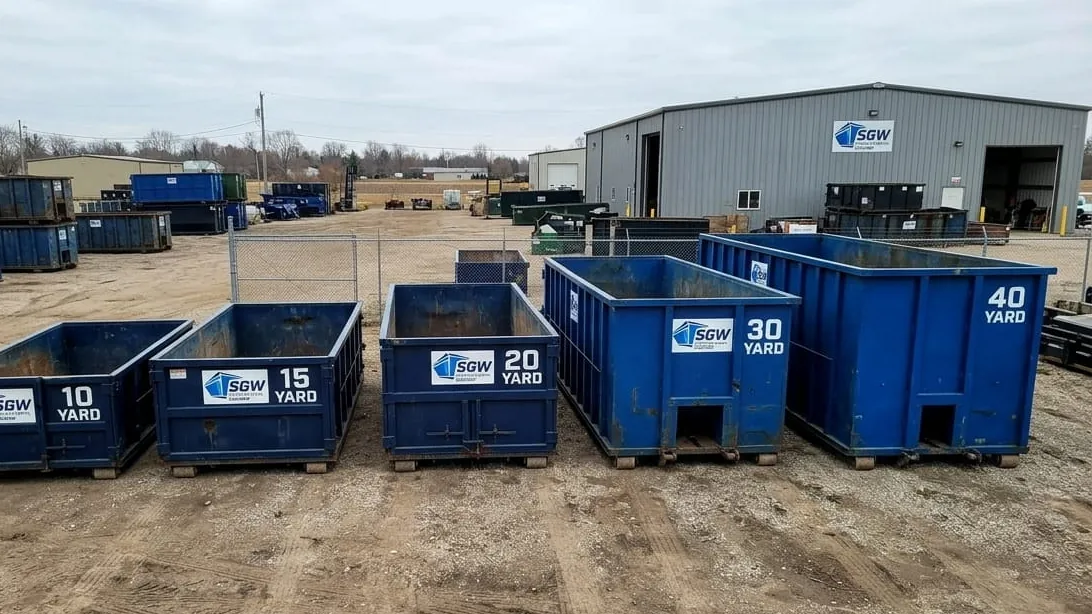
One thing to get out of the way before you do the arithmetic, because on this site you are invited to. The external dimensions published for each box do not multiply out to the number in its name — a 10 yard measured at about fourteen by seven and a half by three and a half feet works out nearer fourteen cubic yards than ten, and every size on the list runs the same way. That is not a trick. The dimensions are approximate external measurements of steel that different manufacturers build slightly differently, and the yardage is the trade name for the size rather than a computed internal volume. Use it to compare the five boxes against each other, and then tell us what is going in, because that is the figure that actually decides the job.
- 10-yard — the small, low-sided box. The right shape for dense, heavy material where the weight limit arrives long before the volume does.
- 15-yard — a middle option, useful for a single large room or a mixed job that is heavier than household goods but lighter than masonry.
- 20-yard — the default for a whole-house declutter, and the one most conversations land on.
- 30-yard — bulky, light material: furniture, cabinetry, carpet, a garage full of accumulated things.
- 40-yard — the largest, and genuinely only right for high-volume, low-density material.
A side-by-side view of all five is at dumpster sizes. We are not going to tell you what sits in the yard on any particular day, because availability changes — call and ask what the board looks like.
Start with the 20, and argue yourself off it
If you want a single default, the 20-yard is it for a whole-house clearout: a house being emptied, a basement and garage done together, an estate cleanout, a move-out where a great deal is going. It is big enough that you are unlikely to need a second box for ordinary household material, and small enough that it will usually sit on a driveway without taking the whole thing.
Then argue yourself off it in one of two directions. Up, if the material is bulky and light — furniture, mattresses, cabinetry, carpet and underlay. Down, and often a long way down, if the material is heavy. Which brings us to the thing that actually decides most of these conversations.
Volume is not the limit. Weight is.
This is the single most useful idea on the page, and it is the one that catches people with construction debris.
A container has two limits running at once: how much space is inside it, and how much weight can lawfully be carried on a truck on a public road. For household goods, space runs out first and the weight limit never comes into play. For anything dense, weight runs out first and the box is still half empty.
The City’s own ordinance is a neat demonstration of the same physics at household scale. § 50.05 allows a 35-gallon container — roughly five cubic feet — and then states that “The weight of the container and its contents may not exceed 50 pounds.” Fill five cubic feet with broken plaster, with ceramic tile, with wet carpet, with soil from a raised bed, and you are at fifty pounds long before the can is full. Everything above that household scale behaves the same way. The whole of § 50.05 is at 35 gallons, 50 pounds, 20 bags.
The practical rule that follows: for heavy material, the smaller box is the right box. A larger container does not let you take more weight. It just gives you more room to exceed the weight limit in.
Roofing never goes in a 30 or a 40
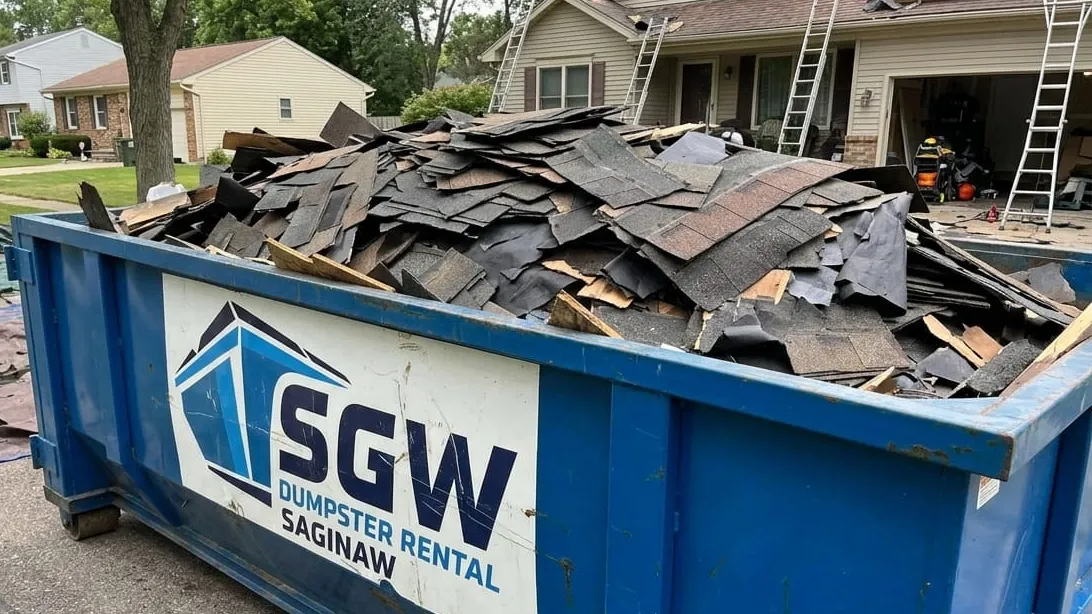
Roof tear-off is the clearest case. Shingles are dense, and a tear-off reaches lawful payload long before it fills a large box. A 30-yard or 40-yard container on a tear-off is not generosity; it is a container that cannot legally leave your property once it is loaded, and it is the wrong tool. Shingles are named in § 50.06(C) by that exact word, so the City will not take them at the curb either. Full treatment at roof tear-off dumpster sizing and on the roofing container page.
Concrete, brick, masonry and soil
The same logic, harder. Concrete, brick, stone, plaster, sand, gravel and earth are all named in § 50.06(C), and all of them are heavy enough that the 10-yard is usually the honest answer — sometimes with the load kept well below the rim. Clean, separated material is also easier to deal with than material mixed in with timber and plasterboard, which is worth knowing before you start throwing everything in together. See concrete and heavy debris.
Sizing by job
A single-room gut
One bathroom, one kitchen, one bedroom taken back to the studs. Plaster, lath, tile, cabinet carcass, subfloor, trim. Plaster and lumber are both named in § 50.06(C). This is usually a 10 or 15 conversation, decided by how much plaster and tile there is — those two materials carry the weight. A kitchen with a tiled floor is heavier than people expect.
A whole-house declutter or estate cleanout
Household goods, furniture, clothing, boxes, the contents of a loft and a basement. Volume rather than weight, so the 20 is the usual starting point and the 30 is reasonable where there is a lot of furniture. The City ordinance is relevant here in a different way: 20 bags a week is the curbside allowance, and a cleanout produces more than that in an afternoon. See estate cleanout and the cleanout checklist.
Garage, shed or small outbuilding demolition
Mixed material: timber, roofing, concrete slab if the slab is coming out too. Reached by both § 50.06(C) and (I). The slab is the deciding factor — take the slab out and this becomes a heavy job sized like masonry rather than a bulky one. See demolition debris. If the structure is a building rather than a garden shed, read demolition debris and asbestos notification first, because there is a ten-working-day clock that catches people.
Landscaping, brush and tree work
Light by volume but awkward in shape, and branches trap a lot of air. Local news coverage of the City’s seasonal yard-waste program — the City’s own pages are closed to automated reading, so that is the source we have and we label it as such — describes one bundle of brush a week, going out with the trash rather than with the yard waste, with branches cut short and secured. Confirm the current rules and dates with the City rather than with us. Separately, § 50.06(I) names tree trimming as an example of contract work the City will not collect — so brush a crew cut for you is treated differently from brush you cut yourself. See yard waste removal.
A contractor on a live site
Mixed construction debris, running over days or weeks, with the mix changing as the job moves through demolition, framing and finishing. Sizing here is about turnaround as much as capacity. See construction containers and roll-off rental.
Where it has to sit, which sometimes decides the size
A container has to be delivered and collected, which means a truck has to get to the spot, and the spot has to take the weight.
Saginaw sits on the flat lake plain of a former glacial lake — the USDA’s Erie-Huron Lake Plain region, coextensive with the EPA’s Saginaw Lake Plain ecoregion. Academic description of the area’s soils refers to heavy clay interspersed with stretches of water-washed sand and gravel. What that means at ground level, in plain terms: firm dry ground carries a loaded container, and ground softened by a wet week or moving through freeze and thaw does not.
Practical measures that take almost no effort: plywood under the wheels and under both rails, which goes down as standard on every delivery, a spot chosen on the firmest ground available rather than the most convenient, and patience in March. The place to put a container is often not the place you first thought of. More on this at driveway protection on Saginaw clay.
Two things we are not going to do. We publish no soil bearing capacity, no frost depth, no water-table depth and no flood-zone determination — we have no source for any of them for this area, and inventing one would be worse than useless. And we are not qualified to assess the ground at your address, which is a limitation we would rather state than paper over. What we can do is talk through the spot on the phone and tell you what we would be worried about.
If the container cannot go on your own ground and has to sit in the street, that is a separate question with a separate answer, and the answer in the City of Saginaw is less settled than you would expect: see do I need a dumpster permit in Saginaw? Note also § 94.068, under which trash or building materials in the street right-of-way draw a posted notice requiring removal within 72 hours, with removal costs assessed against the premises. Contained material is a different proposition from a pile.
Weather, briefly, because it affects sizing decisions
Climate normals for 1991 to 2020 published by NWS Detroit/Pontiac — which is the National Weather Service office covering Saginaw County — for the station the agency labels only “SAGINAW”, show January and February as the only months whose average high sits below freezing, at 29.5 and 31.8 degrees. January’s snowfall normal is 13.9 inches, and December, January, February and March each carry a normal of six inches or more. Five months, May through September, carry a normal of zero. And the wettest month is August, at 3.85 inches, which is not where most people would guess.
Two sizing consequences. A loaded open container collects rain and snow, and water is heavy — a box that was within its weight limit on Friday may not be on Monday, which argues for the smaller box and a quicker turnaround on heavy material. And a job planned for March is a job planned into thaw, which is a ground question rather than a volume one.
Access, overhead and the approach
One more thing can override the size you wanted, and it is worth a walk round the property before you call. A roll-off container is delivered by a truck that has to get in, line up and tip the box off the back, and then come back and winch it on again when it is loaded. That needs a straight-ish run and clear height.
Things that commonly force a smaller container or a different spot: low branches over the driveway, service wires crossing the approach, a tight turn between the house and a fence, a narrow gate, a soft verge the truck would have to cross, a parked car that cannot be moved for the day, and a slope steep enough that the box would want to travel. On a corner lot, the best spot is sometimes round the side rather than at the front.
Measure the length you have available, not just the width. And when you call, mention anything overhead — it is the detail most people forget and the one most likely to turn a delivery around at the curb.
Timing, and the one thing we will not state as a fact
Turnaround affects sizing, because a smaller container emptied twice is often a better answer than a larger one that cannot lawfully move. On availability, including whether anything could go out today, the honest line is to call and ask what the board looks like — we are not going to publish a delivery promise on a web page and then have the day disagree with it.
What we will not put a number on
You will not find a price on this page or anywhere else on this site, and you will not find an included tonnage or a rental period either. Those depend on the job, and we would rather discuss them than publish a figure that is wrong for you. The reasoning is set out at dumpster rental cost in Saginaw.
We are also not going to publish a list of materials we accept or refuse. What we can tell you is what the law and the City ordinance say, which is most of this page, and then ask you what you actually have.
What to have ready when you call
- What the material is — roofing, plaster, concrete, soil, household goods, mixed.
- Roughly how much — rooms, square footage of roof, number of pickup loads you would guess.
- Where it would sit — driveway, yard, street; surface; overhead wires or branches; how tight the approach is.
- Which government you are in, if you know — see which government am I in?
- When you want to start, and how long the job is likely to run.
Then call (989) 272-9034. There is no quote form, no booking screen and no account on this site, so the sizing conversation happens on the phone — which is where it belongs, because the right answer depends on things a form would not think to ask. We are locally owned and operated, and if the smaller container is the right one we will say so.